
May 20, 2026
The Animals Who Were There on D-Day
Dogs, cats, pigeons, horses, and unlikely companions who crossed the English Channel and became part of June 6, 1944.
When people tell the story of D-Day, they usually begin with ships, aircraft, sailors, paratroopers, and soldiers crossing the English Channel toward Normandy, and less often do they mention the animals that went with them.
Some animals had jobs, like carrying messages, searching for danger, assisting in sickbay, or helping move supplies. Others were mascots and companions, familiar faces in places that had become anything but familiar. But they were there too, crossing the Channel alongside hundreds of thousands of men on June 6, 1944.

Dogs probably had the clearest responsibilities. They sniffed for mines, warned of hidden enemy positions, carried messages, and provided companionship in environments where familiarity could matter as much as equipment.
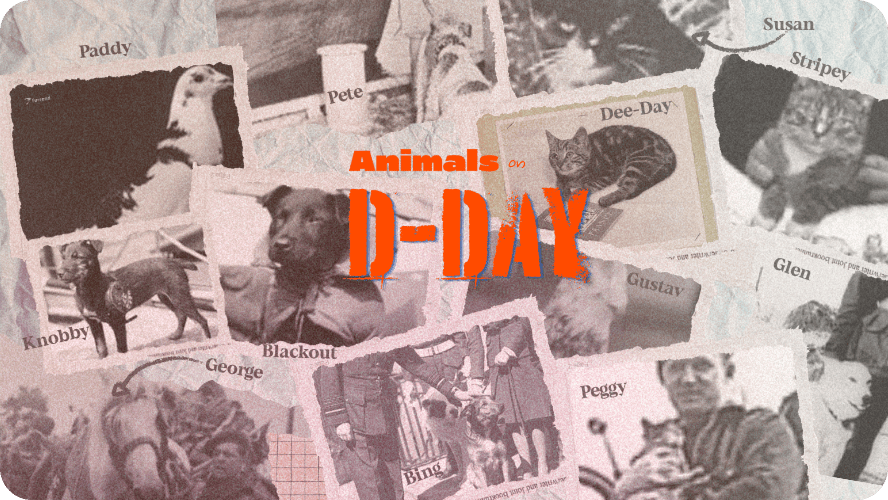
The British airborne forces had three specially trained parachute dogs: Brian, also known as Bing, Monty, and Ranee. Ranee stood out as the only female paradog known to have participated in World War II combat operations, training, and jumping alongside the male dogs. Although all three completed their training jumps successfully before the invasion, D-Day itself apparently felt different. Reports later suggested that even these trained dogs needed some encouragement before stepping into the darkness over Normandy.
Bing later became the best known of the three. He landed with the British 13th Parachute Battalion, survived injuries after being caught in a tree, and continued through the war with the same men. And also with the same Parachute Battalion, a German Shepherd paradog named Glen jumped from a glider with his handler, Private Emile Corteil, along with 700 paratroopers, and both of them were killed by an Allied air strike.
Other dogs served at sea rather than in the air. Blackout the Labrador, Knobby the rescue cutter mascot, and Pete the Pooch of the US Coast Guard all worked around the Normandy operation. Blackout wore a specially made life jacket and eventually earned three battle stars. Pete, the Able Seaman, became known for helping to tie up vessels and leaping into the water to retrieve ropes while working around the captured port at Le Havre.
Not every dog arrived with military paperwork and training. During the invasion, Captain Colin Maud, the British Royal Navy officer later portrayed in The Longest Day, landed on Juno Beach with his dog Winnie beside him. Despite often being remembered as a bulldog named Winston because of the film adaptation, Winnie was actually a German Shepherd. As Maud directed troops under heavy shelling, he reportedly encouraged movement by shouting: "The sooner you people get off this beach, the sooner they'll stop the shelling. It's very bad for the dog." It feels like exactly the sort of line that only appears in wartime because reality occasionally writes dialogue for itself.
Radio silence during the invasion created another problem. Ships approaching Normandy could not simply report back to Britain with updates. So pigeons crossed the Channel too. Gustav was released by Reuters news correspondent Montague Taylor and carried one of the first messages back from the Landing Ship Tank: "We are just 20 miles or so off the beaches. First assault troops landed 0750. Signal says no interference from enemy gunfire on beach..." He traveled 150 miles in five hours and sixteen minutes.
Later that day, another pigeon named Paddy returned from Normandy carrying confirmation that the landings had succeeded. Gustav later received the Dickin Medal, joining dozens of wartime pigeons whose jobs involved carrying information when other methods were unavailable.
Cats appeared almost everywhere. A small tabby kitten named Dee-Day rode aboard a Coast Guard landing ship during the invasion. There is no official record of her duties because there weren't any. She was a mascot, and sometimes that was enough.
Ship cats accompanied crews across the Channel as they had for centuries. Stripey was aboard HMS Warspite when it fired the opening naval bombardment of the Normandy operation. Minnie of HMS Argonaut reportedly slept, ate, and made her usual rounds as the invasion unfolded around her, seemingly unimpressed by the noise and confusion.
Thomas Oscar had his own hammock, mattress, blanket, and toy rabbit tail on HMS Scorpion, the destroyer was at a beachhead offensive on D-Day. Susan, a former street cat turned naval mascot, became close friends with Bosun, the HM Landing Craft T166's dog, and she witnessed several engagements in the English Channel. The Belgian merchant ship SS Julia was transporting ammunition and American troops for the invasion, and the ship's Peggy was "terrified" by all the noises as they were heading to "Bloody Omaha."
Beauty, the ship cat of HMS Black Prince, chose D-Day itself to give birth to three kittens while naval guns bombarded the coast. Her captain later remarked that she carried on with "magnificent indifference to her surroundings," which may still rank among the most accurate descriptions of cat behavior ever recorded.
Even farm animals occasionally became accidental participants. Normandy's fields were heavily mined, but cattle turned out to be useful indicators. Soldiers realized that fields containing curious cows were often safer than empty ones. Cows had little interest in military strategy and an unfortunate tendency to investigate anything unusual, including hidden enemy positions.
Horses arrived later. No cavalry landed on the beaches, but in the days afterward, troops frequently borrowed local horses and carts to move equipment where vehicles could not go. A French horse named George helped haul critical supplies near Pegasus Bridge under enemy fire, while Major Stanley Christopherson later wrote of finding himself galloping through Normandy on a commandeered horse, an experience he had probably not expected to feature in his D-Day memories.
History usually remembers D-Day through numbers, divisions, casualties, and distances. But among all of that were dogs wearing life jackets, pigeons carrying messages home, cats wandering ships, and a kitten named Dee-Day crossing the Channel without the slightest idea what any of it meant.
They were there. We will never forget.
Share this story
More wartime animal stories
More stories
Furrend circle
Be the first one to hear about updates
