
February 9, 2026
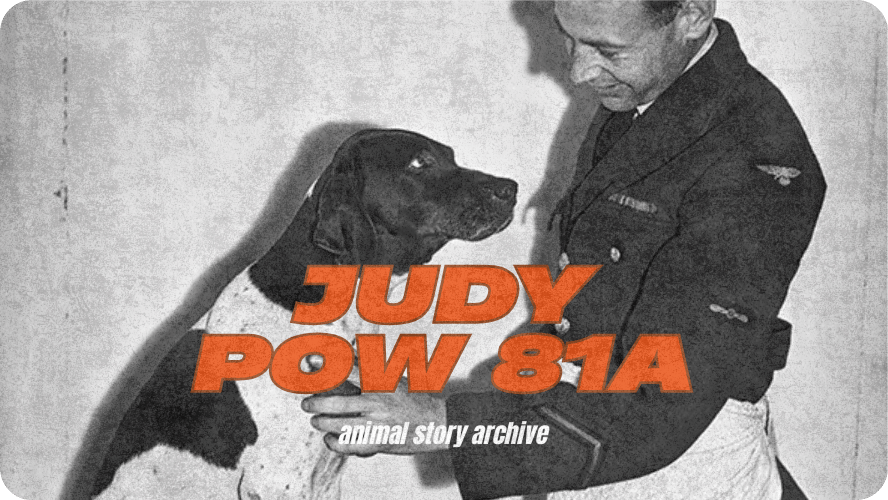
Judy, POW 81A
How a British ship’s dog became the only officially registered prisoner of war during World War II.
During World War II, a British ship’s dog named Judy was officially registered as a prisoner of war in the Pacific. She remains the only dog ever given POW status, and she was awarded the PDSA Dickin Medal, Britain’s highest honor for animals in military service.

Judy was born in February 1936 in Shanghai, one of 7 puppies at a kennel used by European families. She was first called Shudi. Later that year, the gunboat HMS Gnat, operating out of China, went looking for a ship’s mascot. The crew chose her and called her Judy of Sussex.
She joined as a morale dog, sleeping aboard ship, following sailors everywhere, and being cared for by the ship’s butcher, whose official title was Keeper of the Ship’s Dog. Judy took to naval life quickly. She learned the rhythms of the ship, sensed incoming aircraft before alarms sounded, and became part of the crew rather than a pet on the sidelines.
In mid-1939, Judy transferred with crew members to HMS Grasshopper. When war broke out in the Pacific in December 1941, Grasshopper was operating in Southeast Asia. On February 14, 1942, during the Allied retreat, the ship was bombed and ordered abandoned at sea.
The following day, an officer returned to the wreck to check for supplies. From below deck, he heard a faint sound. It was Judy, trapped but alive.
The survivors spent 5 days stranded on what became known as “Shipwreck Island.” Judy located a freshwater spring, helping keep the men alive until they were rescued by a Dutch trawler and taken toward Sumatra. Along the way, she guarded the group from snakes, hunted when she could, and even survived a crocodile attack that left deep gashes in her shoulder.
After 5 weeks in the jungle, the group was captured by the Japanese Army and sent to POW Camp Gloegoer One in Medan. Life there was brutal. Food was scarce, disease rampant, and Red Cross aid nearly nonexistent.
At first, Judy was hidden from the guards. The men shared what little they had, and RAF aircraftman Frank Williams began giving her part of his rice ration. But hiding her was dangerous. If discovered, she could be killed on the spot.
Frank persisted. Through appeals, bribes, and sheer determination, he convinced the guards to register her officially. Judy became POW 81A Gloegoer Medan.
That status changed everything. As a registered prisoner, Judy received rations and protection. She could not be casually disposed of. At the camp, she hunted when possible, fought off snakes and scorpions, distracted guards at critical moments, and stayed close to the men who depended on her as much emotionally as they did practically.
In June 1944, the POWs were ordered onto a transport ship bound for Singapore. Dogs were forbidden. So the men had to smuggle Judy aboard in a rice sack.
The ship was torpedoed. More than 500 prisoners died. Judy survived the sinking and helped wounded men stay afloat.
“When people couldn’t swim,” one seaman later recalled, “Judy pushed pieces of wood toward them.”
After recapture, guards threatened to kill her. A former camp commander, known to be a dog lover, intervened. Weeks later, Judy and Frank were reunited in another camp.
Judy endured forced labor in the Sumatran jungle until liberation on September 4, 1945. Frank made it his mission to bring her home. Once again, she was hidden, this time aboard the troopship Antenor, kept out of sight for most of the 6-week journey back to Britain.
After 6 months in quarantine, Judy was reunited with Frank. She received the PDSA Dickin Medal for “courage and endurance” in captivity. Frank was also honored for keeping her alive.
Judy spent her final years with him in Portsmouth, later moving with him to East Africa. She died in Tanzania on February 17, 1950, at the age of 14, and was buried wrapped in an RAF jacket.
Years later, survivors made sure her story was written down.
“She was a survivor,” Frank recalled.
Judy was just there, alongside the men.
Share this story
More stories
Furrend circle
Be the first one to hear about updates
