

March 18, 2026
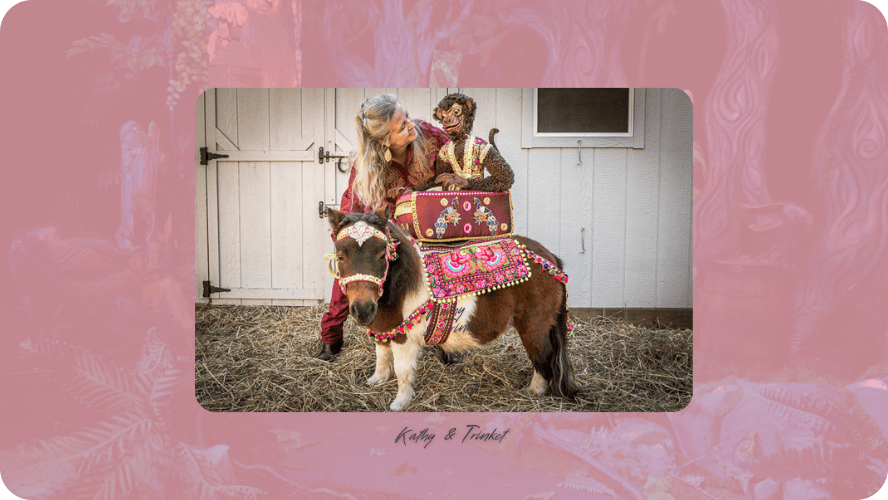
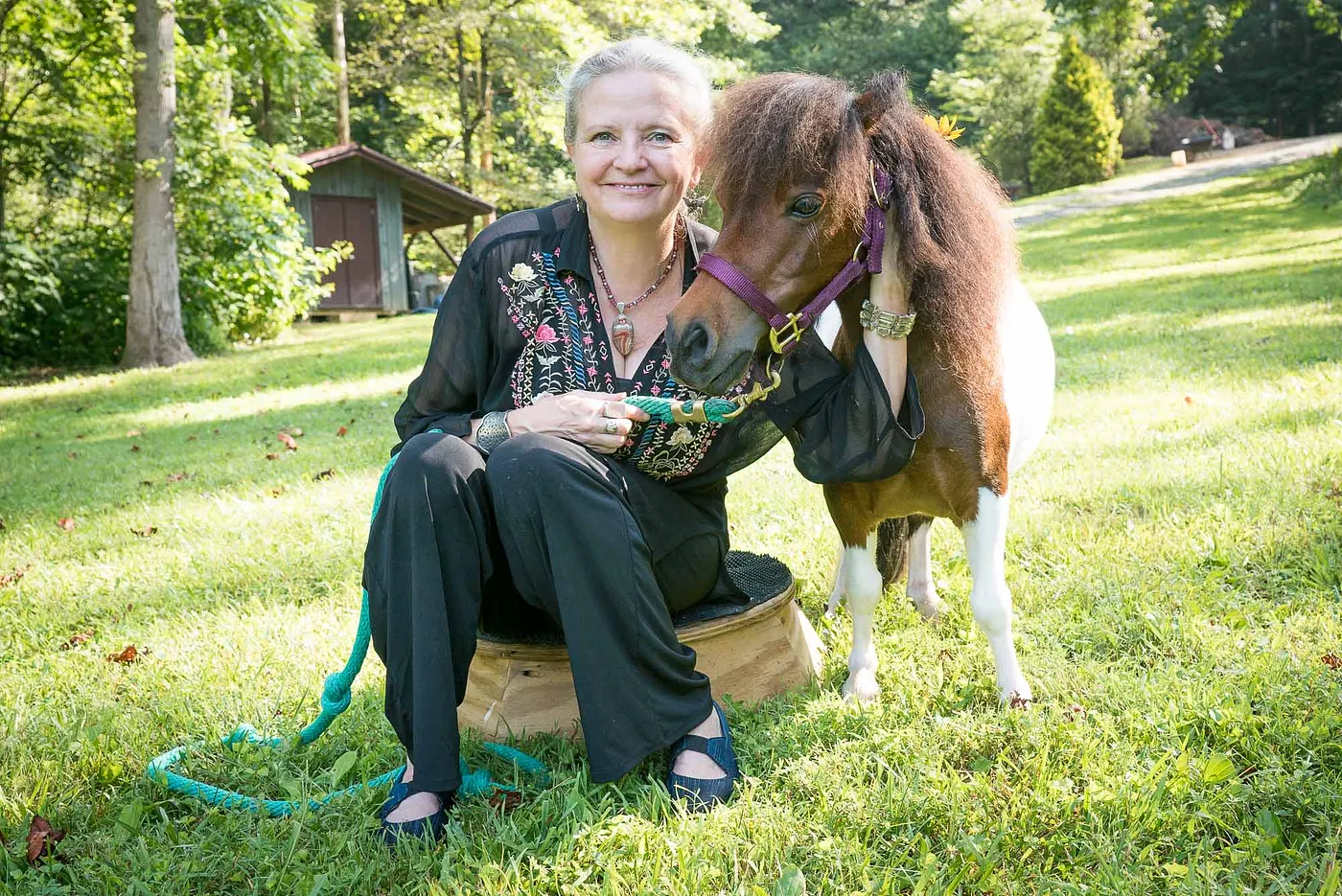
Kathy and Trinket
Costume maker Kathy speaks about her miniature horse Trinket, therapy work with children and patients, and the artistic practice that grew out of their partnership.
For more than a decade, Kathy and her miniature horse Trinket have worked side by side in hospitals, memory care centers, and community spaces where animals are invited to do something words often cannot.
Kathy trained as a theatrical costume maker, and over time, that craft found its way into her work with Trinket. Handmade costumes, puppetry, and performance gradually became part of their visits, creating moments of imagination that allow people to step, even briefly, outside the circumstances that brought them there.
What began as therapy visits eventually grew into a wider creative practice, one that blends animals, costume, storytelling, and healing work. We spoke with Kathy about her partnership with Trinket, the intelligence of horses, and the quiet ways animals can change the emotional atmosphere of a room.

Learning to work together
Trinket will turn 13 this May. Kathy first brought her home when she was just 3 and a half years old, still young in terms of training but already familiar with the basics of therapy work.
But training and partnership are not the same thing.
For Kathy, the early years were spent building something deeper than obedience: a relationship grounded in trust, attention, and the shared responsibility that comes with working closely alongside an animal.
“We spent a long time just developing that partnership,” she explains. “Grazing together, playing, running around, going swimming. And then slowly working through the small steps of training until we felt ready for our first therapy visit.”
Bringing a horse into an unfamiliar environment filled with wheelchairs, medical equipment, and unpredictable movement can be intimidating. Kathy admits she was nervous the first time. Trinket was not.
“She just marched right in there and got the job done.”
What happens when Trinket enters a room
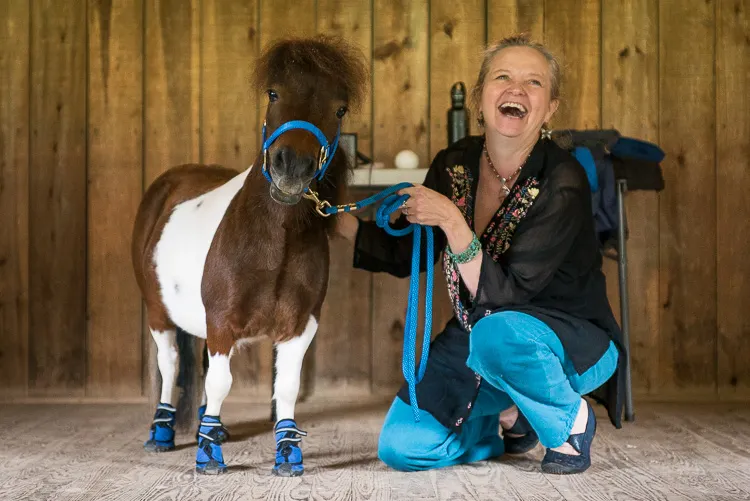
A therapy horse, Kathy explains, requires a rare combination of qualities: curiosity, confidence, emotional sensitivity, and an ability to read situations that people themselves may not fully understand.
Over the years, she has seen Trinket respond to people in ways that feel almost impossible to describe. And one early moment remains especially vivid.
During a visit with a man who was blind, Trinket immediately seemed to adapt to his presence.
“It was like she shifted into his language,” Kathy says. “I can’t quite explain how. They just seemed to meet each other in a way that didn’t require words.”
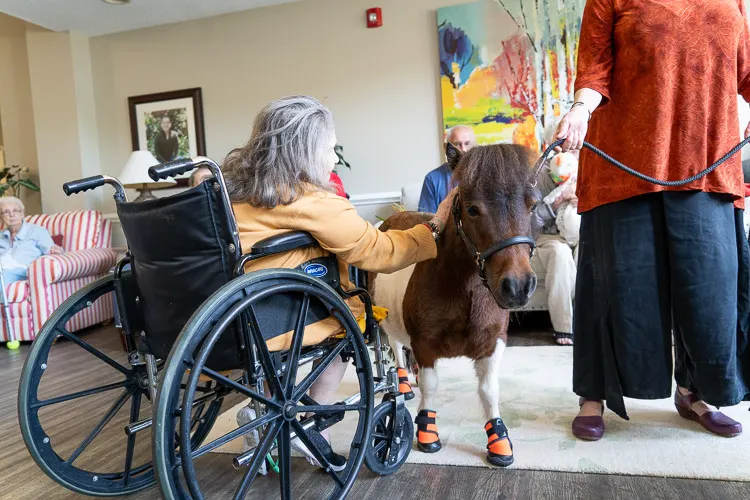
In another visit to a memory care center, the atmosphere initially felt chaotic. Residents began moving toward the horse all at once, and Kathy worried the situation might become overwhelming.
“She took a deep breath and stood completely still,” Kathy recalls. “And the entire room went quiet.”
Moments like that are difficult to explain, even for someone who has spent years observing them. But Kathy has learned to trust the instincts behind them.
“Horses sense emotional currents we often can’t articulate ourselves.”
” A good therapy horse is curious, confident, and deeply intuitive.
The intelligence of a therapy horse
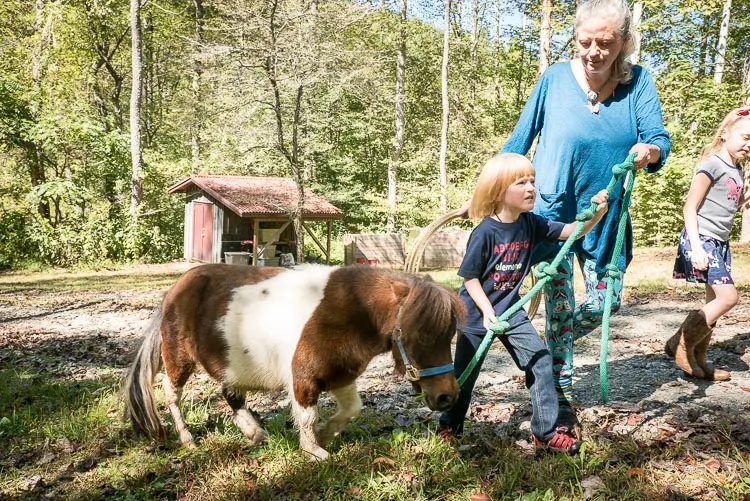
One experience, involving two young siblings, revealed something Kathy still finds astonishing.
A family had brought their children to meet Trinket. The older sister was exceptionally accomplished, already studying languages, playing violin, and excelling academically. Her younger brother, by contrast, had significant special needs and was almost nonverbal.
“There was a painful difference between them,” Kathy recalls. “The little boy was always the one who couldn’t do things.”
When they began working with Trinket, the horse immediately focused her attention on the boy. Kathy guided him through small interactions, allowing him to lead the horse in simple ways.
For the first time, he appeared confident.
The sister quickly grew competitive, insisting she could do the same work without help. And Trinket responded in her own way.
“She pulled the girl straight into the woods,” Kathy says, laughing softly. “Not roughly, but firmly enough that the girl realized she was in over her head.”
Moments later, the girl called for help. Kathy intervened, and Trinket calmly turned and led them both back. The dynamic between the children had shifted.
“The little boy suddenly looked like the expert,” Kathy says. “And by the end of the session, he was holding Trinket and said, ‘I finally have a friend.’”
It remains one of the moments Kathy believes the horse understood more clearly than any human in the situation.
“Horses have a kind of healing intelligence,” she says. “They rebalance things.”
Costume, theater, and imagination
Costume entered the partnership almost naturally.
Kathy has loved costumes since childhood. An early drawing, recently rediscovered by her aunt, shows a stick figure draped with a piece of Kleenex as a makeshift garment.
“I didn’t even put people in my dollhouse,” she laughs. “It was all animals.”
Years later, after leaving the theater industry and moving to the country, Kathy found that the language of costume still shaped how she approached creative work.

When Trinket began visiting hospitals and care centers, elaborate costumes slowly became part of the experience. And something changed when they appeared dressed in theatrical attire.
“When we wore fantastical costumes, people stopped focusing on illness or injury,” Kathy explains. “Instead, they started thinking about stories, parties, imagination.”
Costume created a small shift in perception, one that allowed people to inhabit a different emotional space, even for a moment.
” Costume opens a doorway into imagination.
What horses know about us
For Kathy, the relationship with Trinket has also been deeply personal.
“Horses are like mirrors,” she says. “If something inside you is out of alignment, they sense it immediately.”
Living with trauma and PTSD, Kathy found that working with Trinket gradually helped restore qualities she felt had been lost during difficult periods of her life. Animals, she believes, offer a kind of presence that human relationships often struggle to sustain.
“They create spaces where you can simply exist without judgment.”
It is a form of communication that exists largely outside language, something Kathy describes as intuitive rather than verbal.
“There’s a kind of knowing between beings that doesn’t require explanation.”
” Horses are like mirrors. If something inside you is out of alignment, they sense it immediately. And animals create spaces where people can simply exist without judgment.
Building the healing bridge barn
The work Kathy envisions for the future extends well beyond therapy visits. Her long-term project, Healing Bridge Barn, will combine animals, art, puppetry, and storytelling in a space designed for children coping with anxiety, trauma, or learning challenges.
Trinket remains at the center of that vision.
“She has several jobs,” Kathy says with a smile. “She works in film, she does healing work, she models costumes, and she’s the heart of our little brand.”
But for Kathy, the goal has never been spectacle or internet attention. It has always been about connection.
Animals, she believes, help people rediscover something that modern life often makes difficult: the quiet, attentive space where relationships, between humans, animals, and the natural world, can begin again.
You can visit Kathy's Etsy shop MyMiniandtheMoon, and follow Trinket on Instagram.
Are you a creator with a story like this? We’d love to feature you.
Share this story
More stories
Furrend circle
Be the first one to hear about updates
