
January 26, 2026
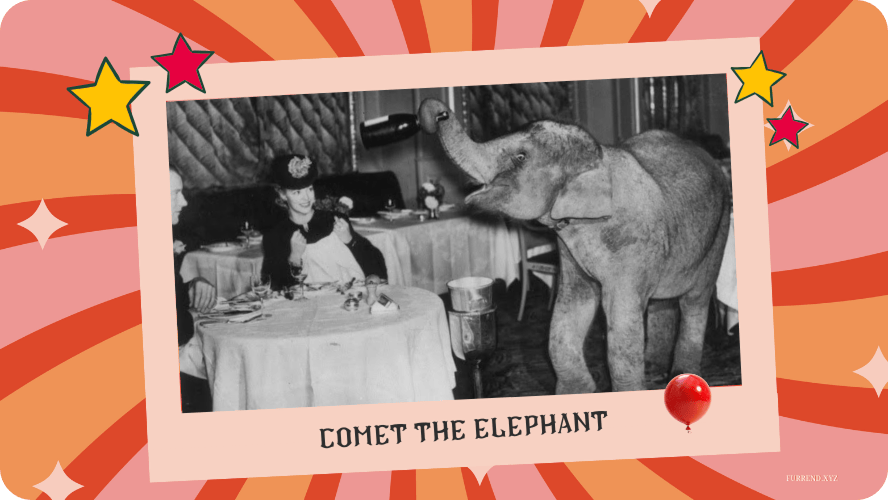
Comet the Elephant, Waiter of Piccadilly Circus
In 1938 London, an elephant named Comet worked as a waiter at the Trocadero Restaurant, part of a performing career that spanned zoos, television, and wartime Britain.
In 1938, guests at Trocadero Restaurant could order dinner, watch the crowd drift through Piccadilly Circus, and be served by an elephant.
His name was Comet.
He carried bottles, posed politely for photographs, and navigated the restaurant floor with the calm confidence of a seasoned professional. It was just simply part of a very different moment in public entertainment, not a stunt in the modern sense.

Comet lived at Chessington Zoo, which opened in 1931 as a hybrid of zoo, circus, and amusement park. In the early 20th century, animal attractions were expected to astonish. Zoos were places of spectacle as much as education, and animals were routinely brought into theaters, restaurants, and public promotions.
Comet fit the era perfectly.
He was an Asian elephant trained by Hans Brick and quickly became one of Chessington’s most visible performers. Beyond the zoo grounds, Comet appeared at theaters, public events, and promotional engagements across London. His most famous role, as a waiter at the Trocadero, placed him directly among diners, turning an ordinary evening out into something unforgettable.
In February 1939, Comet was scheduled to appear on the BBC program "Picture Page." The plan was simple until Comet refused to climb the stairs to the studio. Rather than force the issue, the crew gave up, so cameras were brought downstairs instead, and Comet appeared exactly where he was comfortable.
As war approached, life around him changed. With the outbreak of World War II, Chessington temporarily closed to prevent large public gatherings. Many animals were relocated, and Comet became part of Devon’s Zoo & Circus, a traveling mix of animal exhibition, stage performance, and spectacle.
There is footage from the early 1940s showing Comet at Devon Zoo moving easily through crowds, greeting visitors, and once again serving at tables. He appears calm, focused, and remarkably unbothered by attention. This was considered normal entertainment at the time, not controversial or unusual, but simply part of how animals and audiences interacted.
Later records suggest that around 1951, Comet was sold to Circus Togni, continuing a career that carried him between zoos, circuses, theaters, and television appearances. This path was common for performing elephants of the era, whose lives were shaped by public demand for novelty and wonder.
Comet belonged to a brief and strange chapter in history. A time when elephants worked in restaurants, appeared on television sets still new to most homes, and were treated as both staff and spectacle. He was not famous in the modern sense, but for those who encountered him, he was unforgettable.
Today, his story reads as surreal, even unsettling. But it also offers a clear snapshot of how entertainment once worked, how animals were woven into public life, and how easily the extraordinary could become ordinary.
For a moment in mid-century London, an elephant waited tables in Piccadilly Circus. And somehow, that was just the way things were.
Share this story
More stories
Furrend circle
Be the first one to hear about updates
