
December 30, 2025
The Bear Behind Winnie-the-Pooh
How a real bear named Winnipeg, rescued during World War I, inspired A. A. Milne and became the quiet origin of Winnie-the-Pooh.
Long before Winnie-the-Pooh lived in the Hundred Acre Wood, before the books, the drawings, and the honey pots, there was a real bear. She didn’t speak or wear a red shirt. But she was very much in the real world. Her name was Winnipeg, though everyone called her Winnie.
Her story begins not in children’s literature, but in wartime Canada.

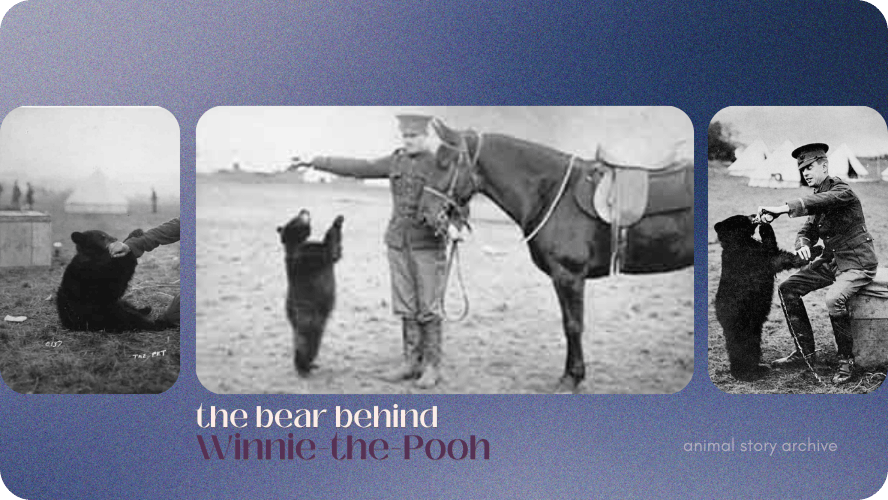
In 1914, as Europe moved toward war, a young Canadian veterinarian named Harry Colebourn was traveling by train through Ontario on his way to military service. Along the route, he came across an orphaned black bear cub being sold by a hunter. For twenty Canadian dollars, Colebourn bought her on the spot. He named her Winnipeg, after his adopted hometown, and from that moment on, the bear became his companion.
Winnie traveled with Colebourn through military training camps, quickly becoming a beloved mascot among the troops. She was gentle, curious, and unusually calm for a wild animal. Soldiers fed her, played with her, and treated her as part of the unit. When Colebourn’s regiment was eventually sent overseas to England, Winnie went with them.
Before the unit departed for France, Colebourn faced a difficult choice. The front lines were no place for a bear, no matter how well-loved. He arranged for Winnie to stay temporarily at the London Zoo, intending to retrieve her after the war.
But the war dragged on. And Winnie stayed.
At the zoo, Winnie’s temperament made her something special. She was known for being friendly and remarkably tolerant of people. Unlike most bears, she was trusted enough that visitors, including children, were allowed to enter her enclosure under supervision. She played gently, accepted food from their hands, and never showed aggression. In an era before modern zoo barriers, she became a favorite.
Among those visitors was a boy named Christopher Robin Milne.
Christopher was captivated by Winnie. He visited her often and eventually renamed his own stuffed teddy bear after her. That personal gesture caught the attention of his father, A. A. Milne, who began writing stories inspired by his son’s toys and imagination.
When Winnie-the-Pooh was published in 1926, the name had already traveled a long way. From a train platform in Ontario, to military camps, to a zoo enclosure in London, and finally onto the page.
Winnipeg herself lived at the London Zoo until she passed away in 1934. Harry Colebourn eventually returned and visited her again, but by then she had become part of something larger than either of them could have known.
Winnie never knew she inspired a story. She never saw a book or heard her name read aloud. But her patience, her gentleness, and her presence left an imprint that lasted far beyond her lifetime.
Sometimes the origins of beloved stories aren’t grand or planned. Sometimes they begin with a soldier, a bear cub, and a moment of kindness on a train platform, and just grow from there.
Share this story
More stories
Furrend circle
Be the first one to hear about updates
