
December 22, 2025
Hoover the Seal Who Sounded Human
The story of Hoover, a harbor seal raised by humans whose voice challenged what scientists thought animals could do.
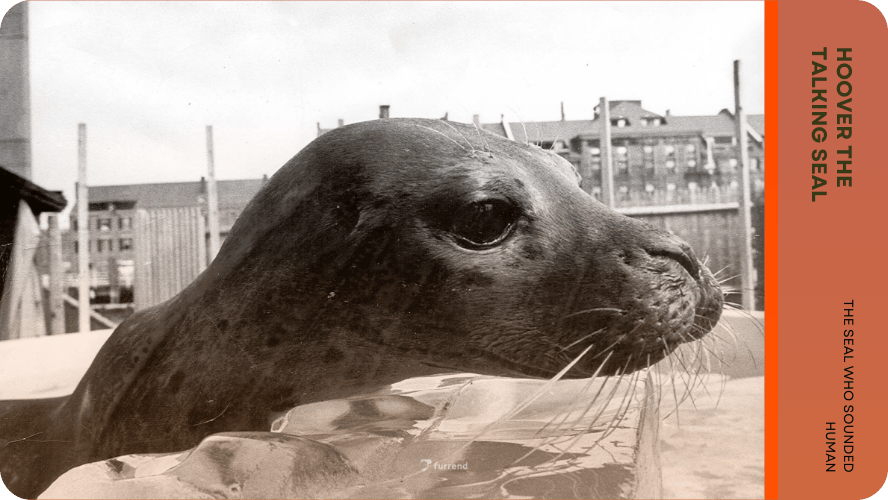
In the early 1970s, a harbor seal was rescued off the coast of Maine and raised in a local family’s home. Years later, people would realize he sounded uncannily human. His name was Hoover.

Hoover had been found as an orphaned seal pup along the Maine coast by a man named Scottie Dunning, who quickly realized the animal needed help. He called his brother-in-law, George Swallow, who agreed to take the pup in. At first, Hoover was small enough to manage indoors. The Swallow family bottle-fed him, talked to him constantly, and tried to keep him in the bathtub until that stopped being practical. Before long, he was living in a small spring-fed pond behind the house, following George everywhere, even riding into town with his head out the car window.
Hoover was raised like a very unusual family pet. He grew up surrounded by human voices, casual conversation, and daily routines. The family spoke to him constantly, the way people naturally do when an animal is nearby. Over time, Hoover grew larger, stronger, and more unmistakably wild. It became clear he couldn’t remain there forever.
The Swallows eventually arranged for Hoover to move to the New England Aquarium in Boston, where he could live safely and be properly cared for. When he arrived, the staff had heard the stories about his voice but were skeptical. Seals are vocal animals, after all, and people tend to exaggerate. At first, no one noticed anything unusual.
Then they started to hear it.
From the water, Hoover made these rough, gravelly sounds that kind of sounded like human speech. You could clearly hear words like “hello” and “come over here,” and he even had a bit of a Maine accent from the people who raised him. Visitors stopped in their tracks, and staff called their colleagues over. They started recording it all. Hoover wasn’t putting on a show or anything, and he wasn’t responding to commands. He wasn’t really in the human sense, but he was doing something remarkable.
Researchers studied his vocalizations and confirmed that Hoover was deliberately shaping sounds he had heard, matching human vowels and consonants through imitation rather than instinct or chance. He wasn’t understanding language or using words for meaning. Instead, he was reproducing the sounds themselves, treating human speech as something to copy, much like birds imitate songs.
At the time, many scientists believed this ability was almost exclusive to humans and birds. Hoover challenged that assumption. His voice became one of the clearest early examples that a mammal could learn to produce entirely new sounds simply by listening.
Hoover lived at the aquarium for decades, becoming a legend among visitors and researchers alike. He wasn’t a trained performer or a spectacle engineered for attention. He was simply an animal shaped by circumstance, raised in close contact with people, and gifted with an unexpected ability to echo the sounds of the world around him.
Like Andre the seal, Hoover belonged to a brief and unusual moment in history. A time before formal rescue systems and strict boundaries, when humans and wild animals sometimes grew up together, and no one quite knew what that closeness might uncover.
Hoover died in 1985 at about 14 years old, but recordings of his voice still circulate today. They can sound startling, funny, even unsettling at first. Beneath the novelty, though, is something deeper. His story reminds us how much we still have to learn about animal intelligence, communication, and the thin, porous boundaries between species.
Sometimes discovery doesn’t arrive through experiments or equations. Sometimes it floats up from the water, rough and gravelly, sounding a little bit like home. By imitating the voices he grew up hearing, Hoover helped reshape how scientists think about vocal learning in mammals, simply by listening.
Find this story on the Atlas →
Share this story
More stories
Furrend circle
Be the first one to hear about updates
