
April 13, 2026
Sergeant Siwash
In 1943, a duck won in a New Zealand pub raffle became the unlikely mascot of the U.S. 2nd Marine Division and followed them through battles across the Pacific.
In 1943, a Marine in New Zealand won a duck in a pub raffle and brought her to war.

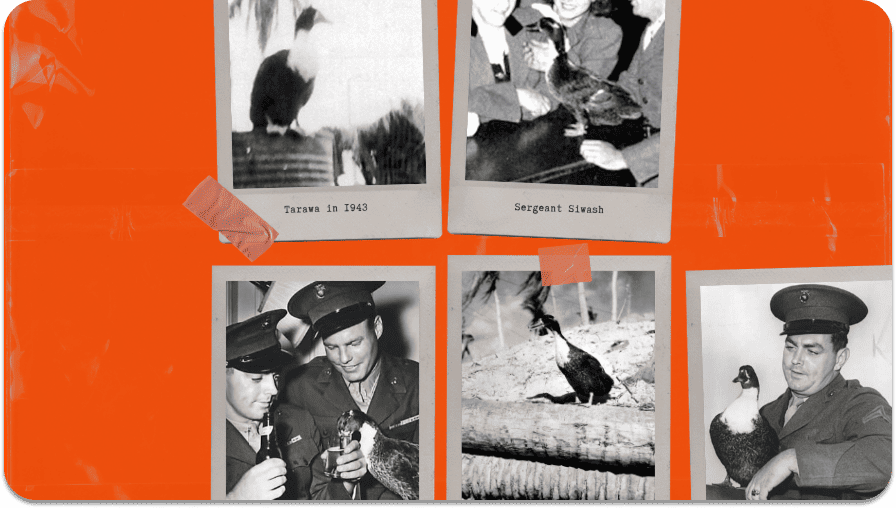
Sgt. Francis “Pappy” Fagan won a duck in a pub raffle, and he named her Siwash, after Sgt. Jack “Siwash” Cornelius.
Within a matter of weeks, Siwash was no longer just a raffle prize but part of the unit. When the Marines of the 2nd Division moved out, she went with them, crossing the Pacific and eventually landing on Tarawa.
At first, there was some "confusion." In official records, Siwash was listed as a drake. The assumption held until the day she laid an egg, which settled the matter more definitively than any paperwork could.
It was not entirely unusual for units to adopt animals during the war. Dogs, goats, birds, the occasional monkey or donkey found their way into camps and onto ships, becoming part mascot, part working animals. Siwash fit into that tradition easily, though she may have been the only one who arrived by raffle.
On Tarawa, one of the toughest battles in the Pacific, Siwash became part of Marine Corps lore and earned the nickname "devil duck."
On the second day of the invasion, she reportedly encountered a Japanese rooster on the beach. What followed was described as a fight, which Siwash won, though not without taking a few hits. The incident was later cited as an example of her bravery, a word used with just enough seriousness to make it stick.
She remained with the division as it moved through the Pacific, including the battles of Saipan and Tinian. Sometimes she was on ships, sometimes back on shore, moving with the same group of Marines from one place to the next.
And on Tinian, she reportedly captured another duck. It was, by most accounts, a decisive operation.
Somewhere along the way, she was given a rank and became Sergeant Siwash. Also, she developed a taste for warm beer.
At social gatherings, Marines would give her a drink. According to one account, after a few rounds, she would shake her head from side to side, which the men took as a sign she was having a good time.
When the war ended, Siwash returned to the United States. She spent a brief period on a farm, which did not suit her particularly well. After traveling across oceans and living among Marines, farm life seemed less interesting. She later appeared at war bond events before eventually retiring to the Lincoln Park Zoo in Chicago.
She passed away from liver disease in 1954.
Siwash had crossed the Pacific, stayed with the same unit through multiple campaigns, and outlived most expectations anyone might reasonably have had for a duck won in a pub raffle.
Not every story from the war follows a straight line. Some begin in a bar, continue across oceans, and end with a duck holding rank. And Sergeant Siwash was one of those stories.
Share this story
More animals with jobs
More stories
Furrend circle
Be the first one to hear about updates
