
April 6, 2026
Ham the Astrochimp
In 1961, a chimpanzee named Ham flew aboard a Mercury capsule, helping NASA understand whether humans could work in space.
In January 1961, a 3-year-old chimpanzee named Ham sat inside a small capsule atop a rocket, waiting for a launch he could not possibly understand, but for which he had been carefully prepared.
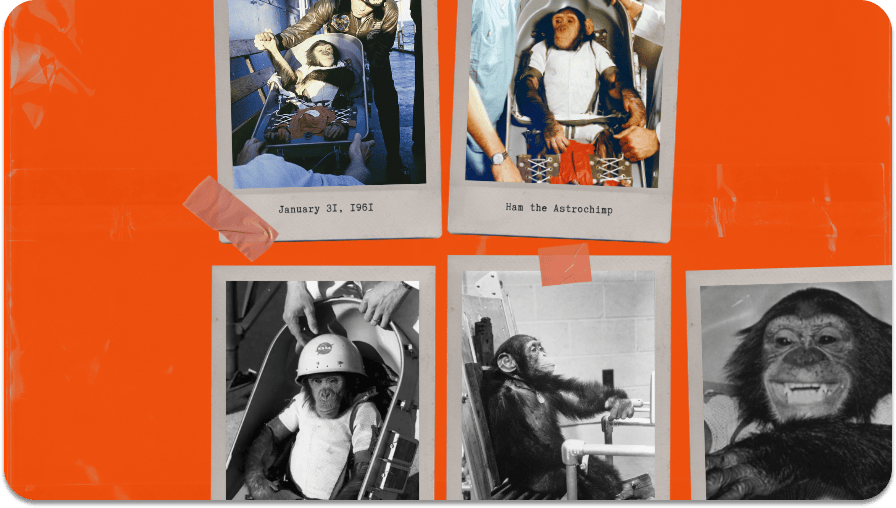
Ham was born in 1957 in what was then the French Cameroons and later brought to the United States, where he became part of a research program tied to NASA’s early space efforts. At the time, the question was simple but unresolved: could a living being perform basic tasks under the conditions of spaceflight? Before sending a human, they needed to know.
Ham was one of forty chimpanzees initially selected for the program. That number was gradually reduced to six. Among them, he was known not by name, but as No. 65.
Training focused on a single idea: response and timing. When a light flashed, Ham had to pull a lever within a set number of seconds. If he responded in time, he received a banana pellet. If he did not, he felt a mild electric shock. The system was precise, repeatable, and measurable. Over the course of 15 months, Ham spent 219 hours practicing, learning the sequence until it became second nature.
“He was wonderful,” his handler Edward Dittmer later said. “He performed so well… just like a little kid.”
On January 31, 1961, Ham was placed inside a Mercury-Redstone 2 capsule and launched.
The flight did not unfold exactly as planned. The rocket traveled higher and faster than expected, and during reentry, the forces on the capsule were stronger than intended. Inside, Ham experienced those changes directly.
Through it all, he kept performing the task. The flight lasted 16 minutes and 39 seconds. When the capsule splashed down in the Atlantic, it had taken on water, and recovery crews moved quickly. Ham was found dehydrated and slightly underweight, but in otherwise good physical condition.
After the flight, he was given an apple.
The data collected during the mission showed that a living being could respond to signals, complete tasks, and function under the stresses of spaceflight. A few months later, Alan Shepard would make his own journey aboard a similar Mercury capsule.
By then, No. 65 had a name. He became Ham, named after the Holloman Aerospace Medical Center, where he had trained.
Ham retired from NASA in 1963 and spent the next 17 years at the Smithsonian National Zoological Park, later moving to the North Carolina Zoo. He lived a long life, passing away in 1983 at the age of 25.
At the time, his mission was described in technical terms. It answered the question it had been designed to answer. And later, people remembered the small details: the training, the signals, the apple, the name that came after the flight. Not just what the mission proved, but who had been there at the beginning of it.
Before the astronauts, there was a chimpanzee in a capsule, doing exactly what he had been taught to do. And then, coming home.
Share this story
More stories
Furrend circle
Be the first one to hear about updates
