
March 2, 2026
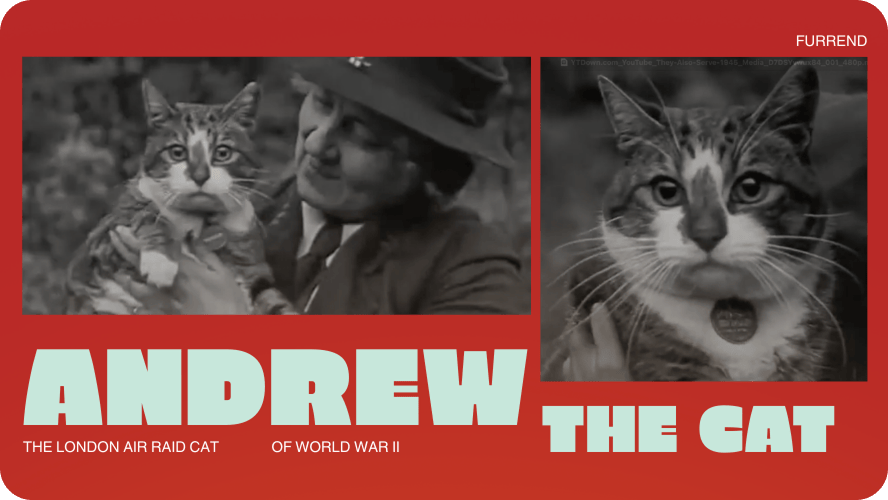
Andrew, the London Air Raid Cat of World War II
During World War II, a tabby cat named Andrew became Mascot-in-Chief of the PDSA’s Allied Forces Mascot Club after showing an uncanny ability to take cover before air raids in London.
During World War II, London relied on sirens, spotters, and lookout posts to warn of incoming air raids. But in one part of the city, residents followed another kind of signal. He weighed nearly 14 pounds, had white socks and an upside-down V for Victory on his nose, and most of the time, he was asleep.

Andrew was a tabby cat who lived through the war in London, where air raid warnings did not always arrive in time. He never served aboard a ship or marched with a unit, but he would later become Mascot-in-Chief of the PDSA’s Allied Forces Mascot Club, an organization formed in 1943 to recognize the animals who supported military units and Civil Defence teams across the Allied forces.
Most of the time, Andrew behaved exactly as you might expect a well-fed city cat to behave. He slept through much of the commotion that defined wartime life. But there were moments when his routine changed. Shortly before certain flying bombs fell in his neighborhood, Andrew would get up from wherever he was resting and move to take cover.
People began to notice the pattern. Whenever Andrew sought shelter, others followed. In a city where official warnings could be delayed or drowned out by the noise of daily life, his movements became an informal signal, one that carried just enough urgency to make people pause and pay attention.
The Allied Forces Mascot Club was created to acknowledge animals who served alongside their human counterparts, sometimes as working partners, sometimes as morale boosters, and sometimes simply by staying present in difficult places. Its membership included creatures attached to units across Britain and beyond, from messenger pigeons to regimental dogs. Some would go on to receive the PDSA Dickin Medal, among them Judy the dog, Simon the ship’s cat, and G.I. Joe the pigeon.
Andrew never left London. His role did not involve carrying messages or guarding supplies. Instead, he remained where he had always been, moving through the same rooms and streets as the people around him, sleeping through the noise until, for reasons no one could quite explain, he decided it was time to hide.
Not every wartime role involved marching. Some involved knowing when to take cover, and trusting the instincts of a cat who had learned to do the same.
Share this story
More stories
Furrend circle
Be the first one to hear about updates
