
February 23, 2026
The Year NASA Learned How to Fall Like a Cat
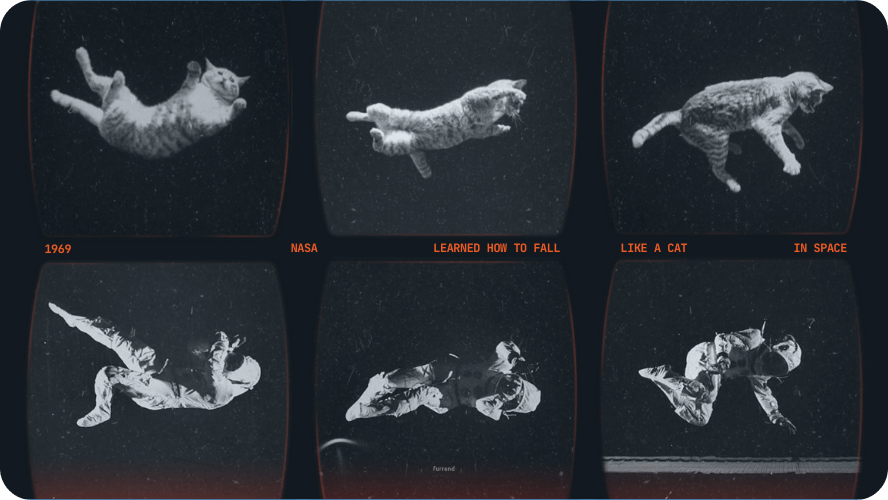
In 1969, NASA-funded researchers studied how cats twist mid-air to help astronauts turn around in zero gravity without pushing against anything.
In 1969, as astronauts prepared to leave Earth and drift into the mechanics of orbit, NASA turned to an unlikely expert in spatial orientation: the common housecat. Long before humans worried about facing the wrong way in zero gravity, cats had already mastered the art of mid-air correction, flipping themselves upright with no visible effort and, more impressively, without violating a single law of physics.
The mystery of the falling cat had been puzzling scientists since the late 19th century. Early high-speed photography revealed something almost magical: drop a cat upside down, and it would twist in mid-air and land on its feet. There was no ground to push against, no external force to guide the movement, just a fluid rotation that seemed to appear out of nowhere.
This led to a simple question. According to the laws of conservation of angular momentum, an object can't simply begin rotating without something to push off. So how was the cat doing it?
The answer turned out to be less about magic and more about choreography.
A cat does not rotate as one rigid object. Instead, it bends its spine and moves different parts of its body in sequence, tucking its front legs while extending its back legs, then reversing the motion. By redistributing its mass and altering its moment of inertia, it rotates one half of its body while the other counter-rotates, allowing the whole system to reorient without any external torque. In other words, the cat changes shape to change direction.
It was elegant, efficient, and in 1969, it became useful.
As space agencies prepared astronauts for life in orbit, a new question emerged: what happens if you start drifting in the wrong orientation in zero gravity? On Earth, you plant a foot, grab a wall, or use friction to turn yourself around. In orbit, there is no floor, no down, and no convenient surface to push against. If you begin rotating slowly, you cannot simply stop by wishing it so.
NASA-funded researchers revisited the falling cat problem and built a mechanical model inspired by feline anatomy. The model demonstrated how an object could twist and reorient itself in mid-air by bending and redistributing mass, even when total angular momentum remained constant.
To test whether humans could mimic the effect, researchers worked with a gymnast on a trampoline, simulating the absence of external support. By carefully coordinating limb movement and body positioning, the gymnast was able to reorient mid-air using the same fundamental physics the cat had been using all along.
The goal was to help astronauts understand how their bodies behaved in freefall, and how subtle internal movements could alter orientation without pushing off a surface. The falling cat became less of a curiosity and more of an instructor.
There is something almost poetic about this. In the same year humans walked on the Moon, we were still studying a household animal to understand how to turn around properly in space. The cat, indifferent as ever, had solved the problem generations earlier while falling off kitchen counters.
Space travel may have been humanity’s great technological triumph. But when it came to mastering zero gravity, the first real experts had whiskers.
Share this story
More stories
Furrend circle
Be the first one to hear about updates
