
May 17, 2026
Lady Moe the Flying Donkey
During WW2, a donkey named Lady Moe flew a combat mission and became one of the most photographed mascots.
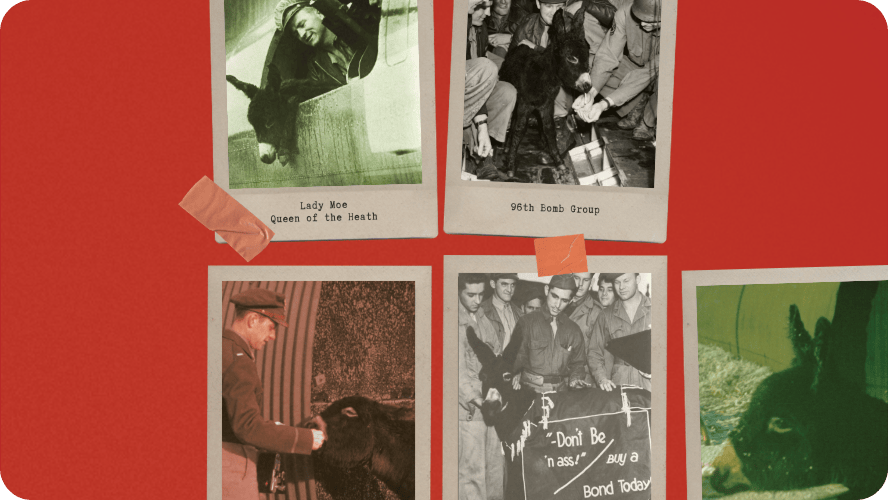
In 1943, a donkey named Lady Moe joined a US Army Air Forces bomber crew during the Second World War and somehow went from a chance purchase in North Africa to becoming one of the war’s most photographed mascots.

Lady Moe's story began after the costly Schweinfurt-Regensburg mission, when members of the 96th Bomb Group found themselves stranded in Algeria with several unexpected days of waiting ahead of them. Crews who had spent weeks thinking about planes, targets, and survival suddenly had something unfamiliar on their hands: free time.
Someone suggested getting a mascot. The first idea was a camel, which seemed like a good idea until someone raised the practical question of how exactly one gets a camel into a B-17. And then a local boy mentioned that his family had a donkey for sale. Ball turret gunner Lou Klimchak and co-pilot Jim Harris went to see her. According to Harris, the animal they found looked tiny, underfed, and as though she had not had a particularly lucky start in life. The asking price was 800 francs. They negotiated it down to 400 and brought her back to camp. She was named Lady Moe.
A few days later, Lady Moe did something that was apparently considered reasonable under wartime logic and boarded an aircraft. The crew placed her inside the bomber’s radio compartment, wrapped her in blankets, and improvised an oxygen mask so she could survive the journey to England. Against all expectations, the flight went smoothly, making Lady Moe what was likely the only donkey to complete a combat mission aboard a B-17.
Once in England, she settled into base life with very little concern for military hierarchy. She had her own straw-lined tent, but preferred wandering through the quarters of enlisted men and inspecting meal trays in search of better options. This arrangement reportedly continued without issue until one morning she inserted her nose directly into the group commanding officer’s breakfast, after which new dining boundaries were introduced.
She also developed opinions. Crew members later recalled that Lady Moe happily ate cigarettes regardless of brand and had a particular fondness for Ping bars, a chocolate candy one airman described in a way that strongly suggested he did not consider them fit for human consumption. If food was not arriving quickly enough, Lady Moe expressed her dissatisfaction loudly and with determination.
Soon, she was everywhere. She appeared in newspapers and magazines, took part in charity and war bond events, and even met the Queen Mother. At one point, Time Magazine reportedly called her the most photographed member of the 96th Bomb Group, which may have been mildly disappointing for everyone else in the group. One officer later complained that he had joined the military to serve his country, not become a valet to a donkey, answering fan mails and driving her around.
Lady Moe survived the war, although accounts of her later years differ. Some veterans believed she eventually lived out her days on a farm, and others remembered less certain endings.
But for a donkey bought almost by accident during an unexpected delay in North Africa, she traveled surprisingly far. Not bad for a mascot that only existed because a camel seemed impractical.
Share this story
Animals with jobs
More stories
Furrend circle
Be the first one to hear about updates
