
August 27, 2026
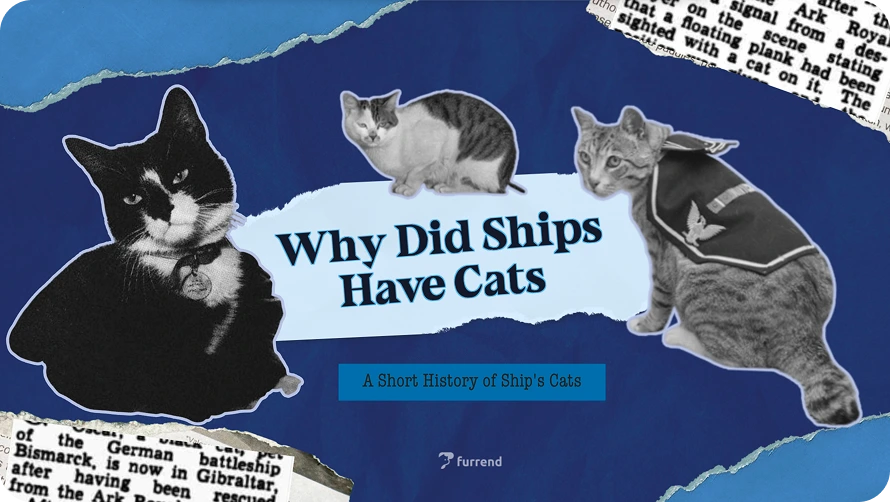
Why Did Ships Have Cats?
For centuries, cats sailed along with traders, explorers, and sailors. They had a job to do, but that wasn’t the only reason they stuck around.
About 9,500 years ago, someone buried a cat next to a human on the island of Cyprus. We don't know whether that particular cat ever lived on a boat, but since Cyprus is an island and cats weren’t originally there, they must have crossed the sea with humans somehow. And that wasn’t going to be the last time.
For thousands of years, cats traveled on trading ships, exploration vessels, merchant ships, and warships. Some were on the job, some were just mascots, and a few even became crew members, complete with names, hammocks, food allowances, and sometimes even tiny uniforms. But it usually all started with rats.

Cats followed the food
The whole history of cats living with humans is tied to farming. Once people started growing crops and storing grain, mice and rats showed up too. And then, wildcats came and followed them. It turned out to be pretty handy for humans to have a little predator hanging around their food stash.
The same problem existed at ships. They carried grain, dried foods, and other supplies on trips that could last for weeks or months. Rats and mice loved to munch on the provisions, wreck cargo, and chew through ropes, sails, and other equipment.
So, bringing a cat on board was a relatively simple solution. They didn’t need much room. They could squeeze into tight spaces. They were great hunters, needed little training, and were definitely easier to keep around than most other working animals.
They were also impressively good at staying balanced when everything was rocking around. A cat’s inner ear gives them an amazing sense of balance, which is why they’re known for always landing on their feet. So if you’re working in a constantly moving environment with rats hiding out, having a cat around isn’t a bad choice at all.
Cats went wherever people went
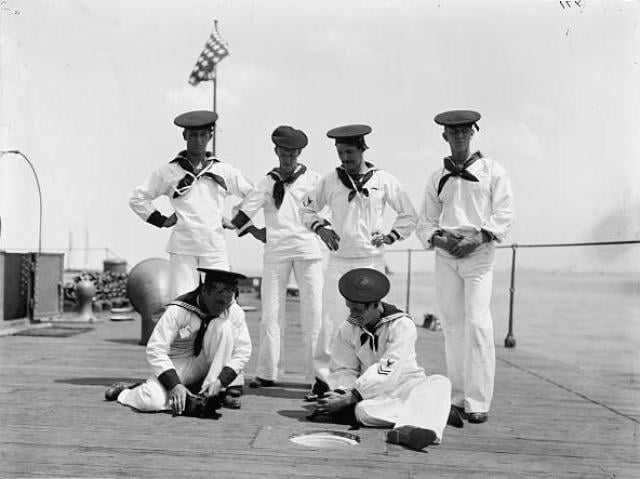
Cats didn't just work on ships. Ships may have helped cats spread around the world. Ancient DNA research suggests that domestic cat populations expanded along human trade routes. Those cats from ancient Egypt showed up far beyond their homeland, making their way through Mediterranean trade channels and into Europe.
Scientists have even found genetic links between cats from ancient Egypt and those at Viking-era sites in northern Europe. It doesn’t mean every one of those cats had their own hammock and a spot on the crew list, but it does show how closely cats traveled with people.
By the time long-distance trade was a thing, cats were so common on ships that their value was recognized in writing. A maritime rulebook called the Consolato del Mare, published in Barcelona in 1494, even mentioned what to do if rats ruined the cargo. If a shipmaster had cats on board, they could avoid being held responsible for any losses. So by the 15th century, having a cat on a ship was all about managing risks at sea.
Somewhere along the way, cats became part of the crew
Sure, they were great for catching rats, but sailors also got attached to them. Life at sea could mean being away from home for months, cramped with the same folks, and not much else going on. Cats became companions as much as workers.
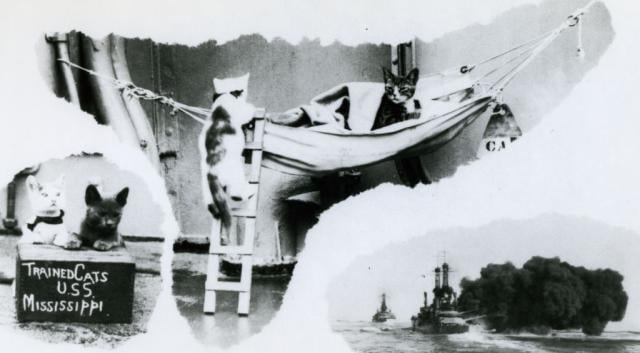
Sailors gave their cats names, took photos of them with the crew, and made comfy spots for them to sleep. Some navy cats even had little hammocks and uniforms.
During World War I, thousands of stray cats found their way to the British military. Cats on Royal Navy ships even got a weekly allowance of one shilling and sixpence for food and treats from the ship’s canteen. It was like they were on the payroll, well, sort of.
Sailors also picked up plenty of beliefs about their feline crewmates. Black cats, for instance, were often thought to be lucky. If a cat didn’t want to board a ship, it could be seen as a bad sign. Changes in a cat’s behavior were sometimes taken as warnings about the weather.
Some of these beliefs were just superstitions, but when you spend months at sea with the same cat, it makes sense that you start paying attention to what they’re up to, especially if they suddenly seem eager to be somewhere else.
The ship's cat had more than one job
By the 20th century, some ship's cats were still very much working animals.
Simon, the cat aboard HMS Amethyst, was one of them. In 1949, Amethyst came under fire on the Yangtze River. Simon was badly wounded by a shell blast but survived. While the ship and its crew remained stranded for weeks, rats threatened their already limited food supplies. So, Simon got back to work. He hunted the rats, including a particularly troublesome one the crew had nicknamed “Mao Tse-tung,” and spent time with injured sailors during their recovery.
His efforts got him a promotion to “Able Seaman” and the PDSA Dickin Medal, making him the only cat ever to receive that honor.
Then there was Unsinkable Sam. According to the famous story, Sam survived the sinking of three ships during World War II: the German battleship Bismarck, HMS Cossack, and HMS Ark Royal.
Read the story of Unsinkable Sam, and the photo mix-up
But stories like Sam's tell us something else about ships' cats. By this point, they were part of maritime folklore, not just pest control.

Some cats went much farther
Ship's cats weren’t just on naval or merchant ships. Back in 1956, a male calico named Takeshi boarded the Sōya with Japan's first Antarctic research team.
Male calico cats are extremely rare, and in Japan, they were thought to bring good luck at sea. They brought Takeshi along as the team's mascot and a charm for their trip south. He made it all the way to Antarctica.
Takeshi wasn’t there to catch any of those ship rats that don’t actually exist on the continent. His role was more about being a companion for the crew, becoming that friendly face in a really unfamiliar place.
It wasn't only cats
Cats may have been particularly practical shipmates, but sailors brought plenty of other animals aboard. Dogs, monkeys, birds, and even way more unusual pets have served as ship mascots over the years.
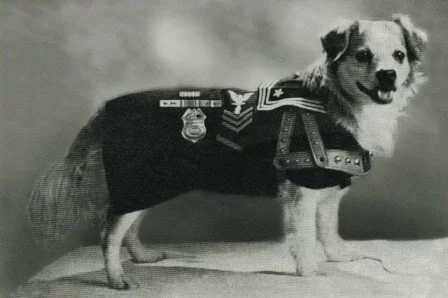
One famous example is Sinbad, a mixed-breed dog who joined the US Coast Guard cutter Campbell in the late 1930s. Sinbad became such a part of ship life that he had enlistment papers, his own bunk, a uniform, and even showed up for roll call. He eventually earned the title of Chief Petty Officer, Dog.
Sinbad had a battle station, earned war ribbons and battle stars, got into enough mischief to get in trouble more than once, and even took a long nap through a 12-hour attack by German submarines. That's definitely one way to handle a tough situation.
The reasons for bringing different animals aboard varied, but they often served the same purpose: giving the crew something familiar to care for while they were far from home.
So, what happened to ship's cats?
Ships changed over time. Better sanitation and modern pest control made cats less needed for keeping rodents away from supplies. Plus, quarantine rules made carrying animals between countries increasingly complicated.
And navies became rather less relaxed about crew members acquiring pets along the way. In 1975, the Royal Navy ended the practice of taking animal mascots to sea. The long age of the naval ship's cat was effectively over.

These days, you might still find some cats on private boats or working vessels, but the time when cats were considered regular crew members on ships is mostly a thing of the past. It lasted a surprisingly long time, too.
Cats boarded ships mainly because humans had a rat problem. In doing so, they crossed oceans, traveled with traders and explorers, slept in tiny hammocks, appeared in crew photos, and even got ranks and medals. They helped spread the domestic cat population along the same routes humans traveled. They started out as rat catchers, but ended up being much more than that.
Share this story
Animals at war
More stories
Furrend circle
Be the first one to hear about updates
