
July 10, 2026
Myrtle the Parachick
In 1944, a chicken named Myrtle completed six training jumps with the British 1st Airborne Division, earned her parachute wings, and went to Arnhem for Operation Market Garden.
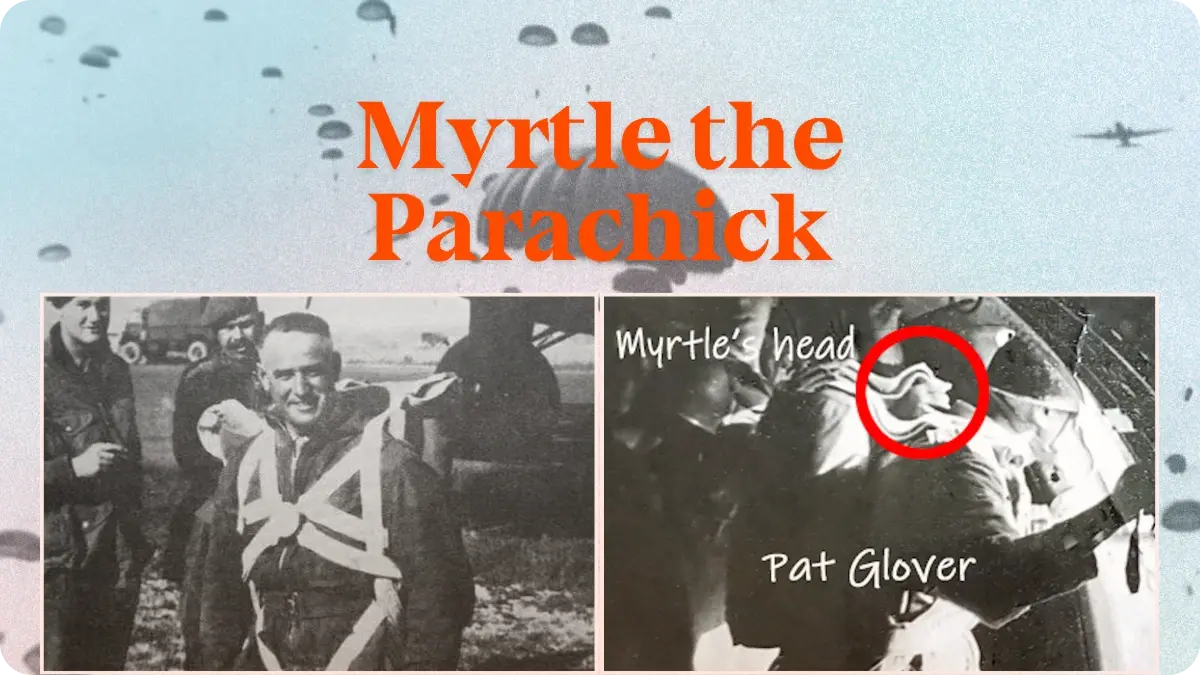
In the summer of 1944, while the British 1st Airborne Division waited for its next operation, Lieutenant Pat Glover and some of his fellow soldiers got into an argument about whether chickens could fly. Glover decided to settle it with a chicken.

The chicken was acquired from a farm near Somerby in Leicestershire, where the 1st Airborne Division was preparing for operations in Europe. Glover named her Myrtle and brought her along on a training jump in a musette bag.
On the way down, he released her at about 50 feet. Myrtle landed safely, although not elegantly.
That should probably have settled the argument, but Glover kept going. Myrtle joined him on more training jumps, and each time, he released her from a greater height. Eventually, she could make her way down from around 300 feet and wait on the ground for Glover to collect her.
After completing six jumps, the required number for a military parachutist, Myrtle was given her own parachute wings. Glover fastened them around her neck with an elastic band.
By then, Myrtle had also become his companion. Glover kept her in his office and, when anyone asked why a chicken was living with the paratroopers, he would say she was “living rations.”
In September 1944, the waiting ended. The 1st Airborne Division was sent to the Netherlands as part of Operation Market Garden, the enormous Allied attempt to capture a series of bridges and open a route into Germany. Glover and the 10th Parachute Battalion were sent toward Arnhem, the furthest objective and the one that would become the most difficult to hold. And Myrtle went with them.
On September 18, Glover boarded a C-47 Dakota with Myrtle inside a canvas bag. This time, he decided not to release her during the descent. As the aircraft approached the drop zone under fire, Glover was the first man out, and when he reached the ground, he deliberately rolled onto his right shoulder to protect Myrtle on his left. They both landed safely.
The battle around them was already much worse than expected. Glover handed Myrtle to his batman, Joe Scutt, while the men moved toward their rendezvous point and fighting spread across the area.
During a German attack, Myrtle was left in her bag beside a trench. When the fighting eased and Glover asked about her, the men found that the bag had been hit by gunfire. Myrtle was dead.
Glover and Scutt buried her beneath a hedge a few yards from where she fell. Glover considered removing her parachute wings, then decided not to. She had been killed in action, so the wings stayed with her.
The Battle of Arnhem continued for days, and the British 1st Airborne Division suffered devastating losses before the surviving troops were ordered to withdraw across the Rhine.
Myrtle's story was not forgotten. 50 years later, in 1994, a stuffed chicken representing Myrtle returned to Arnhem for the anniversary commemorations and went up again with the paratroopers. Glover was there to see it, although another soldier carried Myrtle's stand-in during the jump.
Years later, a beer was even named after her in Leicestershire, where her parachute training had begun.
It is easy to smile at the beginning of Myrtle's story. A group of soldiers argued about whether chickens could fly, and one man went to extraordinary lengths to prove a point. By the time they reached Arnhem and tried to go a bridge too far, Myrtle had made six jumps, earned her wings, and become part of the group. So when the men buried her, they left the wings on.
Share this story
Animals with jobs
More stories
Furrend circle
Be the first one to hear about updates
