
August 29, 2026
10 Ship's Cats and the Ships They Called Home
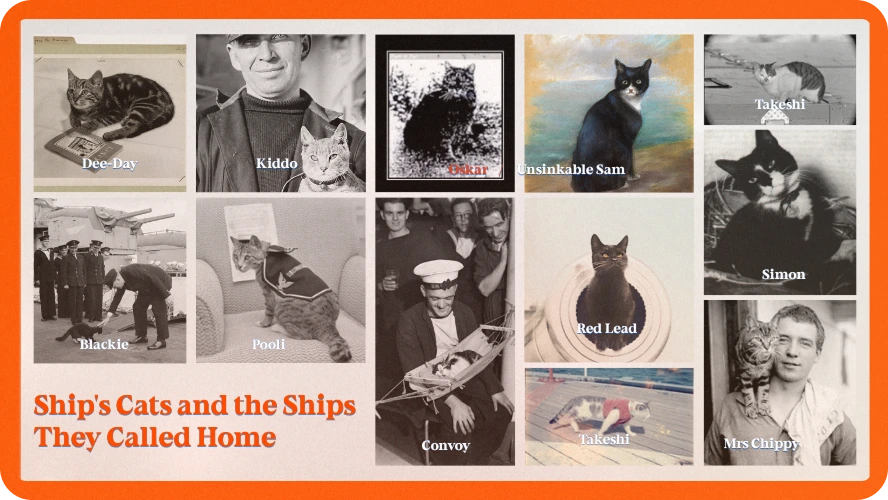
They sailed on warships, exploration vessels, and expeditions to Antarctica. One even got his own biography.
Cats have been part of life on the sea with sailors, explorers, and traders for centuries. Most of the time, they came along for a pretty good reason: ships had a rat problem, and cats were experts at dealing with it. Some ended up in history books. There was one that traveled all the way to Antarctica, one that survived the Yangtze Incident, and even a cat that lived through three ship sinkings.
Here are 10 ship's cats and the ships they called home.

1. Trim and HMS Investigator
Trim was born at sea in 1799 on the HMS Reliance, somewhere between the Cape of Good Hope and Botany Bay. He caught Matthew Flinders's attention early on when, as a kitten, he fell overboard. Instead of sinking into the ocean, he swam back to the ship, grabbed a rope, and climbed back on board. Flinders was pretty impressed.
Trim went on to join Flinders aboard the HMS Investigator during the expedition that circumnavigated Australia in 1803. He wasn’t the only cat on board. Ships usually had cats to deal with rats and mice, and Trim did his fair share of hunting. But he was more than just a mouser. He was sociable and loved to chase balls on the deck, join Flinders for dinner, and he became a favorite among the crew.
More adventures were in store for him. After the Investigator was deemed unseaworthy, Trim and Flinders hopped on the HMS Porpoise for the return trip, but it wrecked on the Great Barrier Reef. Trim made it through that too. When Flinders got detained by the French in Mauritius, Trim stuck by him until he vanished in 1804.
Flinders never forgot Trim. While he was still in captivity on Mauritius, he wrote A Biographical Tribute to the Memory of Trim, calling his buddy “the best and most illustrious of his race.” Even over two hundred years later, statues of Trim stand proudly next to Flinders in Australia and England.
2. Mrs. Chippy and Endurance
Mrs. Chippy was actually a male cat, and he belonged to Harry “Chippy” McNish, the carpenter on Ernest Shackleton's ship, the Endurance. He got his name because he followed McNish around like a devoted partner.
Mrs. Chippy joined the Imperial Trans-Antarctic Expedition in 1914. While cats had been shipmates for ages, this trip was heading to some serious harsh conditions. The ship got stuck in Antarctic pack ice in early 1915 and drifted for months, but Mrs. Chippy managed to adapt.
He seemed to handle life on the ship pretty well. He could balance on narrow rails even when the seas were rough, and Captain Frank Worsley even said he climbed the rigging like a pro sailor. There was one time he even leaped through a porthole into the ocean, and the crew had to turn the ship around to rescue him. The ship's biologist ended up fishing him out with a sampling net.
In October 1915, when the ice crushed the Endurance, Shackleton said the crew could only keep the essentials for survival. Unfortunately, that meant Mrs. Chippy was put down, along with some of the expedition's dogs.
Years later, a bronze statue was put on McNish's grave in New Zealand. It was kind of a sweet tribute, bringing the carpenter and his cat back together after they ended up on opposite sides of the world.

3. Blackie and HMS Prince of Wales
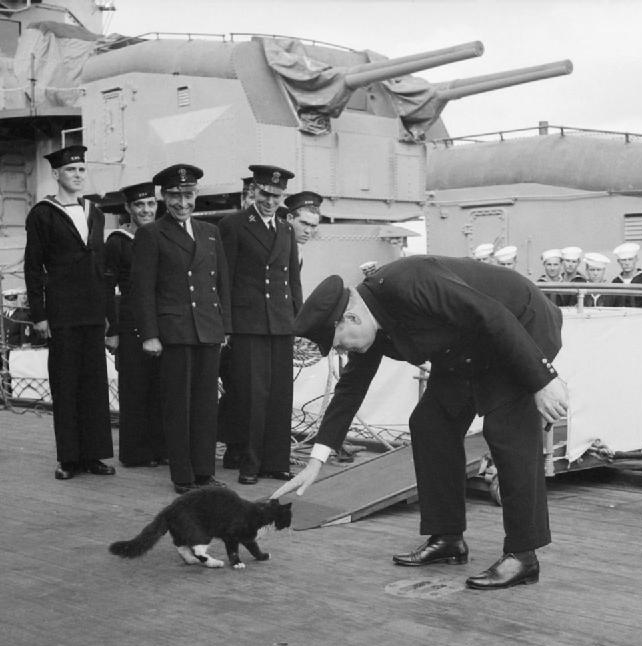
Blackie was the ship's cat on the HMS Prince of Wales, a battleship that the Royal Navy launched in 1939. In August 1941, this ship took Prime Minister Winston Churchill across the Atlantic for a secret meeting with U.S. President Franklin D. Roosevelt in Newfoundland, and Blackie was along for the ride.
When they arrived for the Atlantic Conference, Blackie decided to check out the American side of things. While the crew stood at attention for the U.S. national anthem, Blackie started wandering over to an American destroyer USS McDougal tied up next to them. Churchill noticed and stooped down to stop him.
A photographer snapped the moment, and those photos went viral, making Blackie one of the most famous ship's cats during World War II. After that, he was said to be renamed Churchill as a nod to the human Prime Minister, who had just finished a big meeting that helped lay the groundwork for the Atlantic Charter. So there they were in the news, a cat and a PM, both stealing the spotlight.
4. Simon and HMS Amethyst
Simon was on the HMS Amethyst in 1948 when a young sailor spotted him wandering around Hong Kong looking all scraggly.
Fast forward a year, and things got intense when the ship came under heavy fire while cruising down China’s Yangtze River. Simon took a hit, shrapnel messed up his legs and back, and burned off his whiskers and eyebrows. But he pulled through.
As Simon healed up, the ship was stuck on the river for over three months. Food was getting tight, and rats had become another problem. So Simon decided it was time to get back to work. He went on a rat-hunting spree, catching one pesky rodent the crew named “Mao Tse-tung.” When the Amethyst finally made its escape, Simon became a celebrity. He was awarded the PDSA Dickin Medal, making him the only cat ever to receive it.
His story even made it to the movies. The 1957 movie Yangtse Incident: The Story of H.M.S. Amethyst recreated the events aboard the ship. Simon was played by an unidentified tuxedo cat, who can be spotted hanging around the sailors and resting in a hammock.
Sadly, Simon didn't live to see himself played on screen. He passed away in quarantine back in 1949, just after getting back to Britain.
5. Convoy and HMS Hermione
Convoy was listed in the HMS Hermione's book as part of the crew. The black-and-white cat served on the Royal Navy cruiser during World War II and had his own little hammock, where he was photographed sleeping while the ship was at sea. His name came from Hermione's work escorting Allied convoys through the Mediterranean.
Tragically, on June 16, 1942, HMS Hermione was hit by a torpedo from the German submarine U-205 while south of Crete and sank quickly. Convoy was lost that day, along with 87 crew members. The little hammock he used still appears in one of the photos, keeping his memory alive on the ship.
6. Pooli and USS Fremont
Pooli was born on the Fourth of July. Specifically, July 4, 1944, at the naval yard in Pearl Harbor. A sailor named James Lynch found the little kitten and brought her aboard the USS Fremont, an attack transport ship. She was part of the crew during WW2 in the Pacific theater.
Pooli traveled thousands of miles with the ship and was around for missions in places like the Mariana Islands, Palau, the Philippines, and Iwo Jima.
Once the war was over, Pooli went home with Lynch. Then, celebrating her 15th birthday in 1959, she put her Navy uniform on again. There’s a cool photo from that day showing Pooli in a tiny uniform, all decked out with three service ribbons and four battle stars.
7. Red Lead and HMAS Perth
Red Lead got her name before she was technically supposed to be aboard the ship. In November 1941, HMAS Perth was preparing to leave Sydney when a young girl named Pat Firminger handed a tiny grey-and-white tabby kitten to Able Seaman Bob Collins. Pets weren’t allowed, so Collins snuck her aboard by hiding her in his jacket. He initially hid her in the ship’s paint locker, but that didn’t go too well. The curious kitten knocked over a pot of red lead paint and left little paw prints everywhere. And just like that, she got her name.
Later on, Collins introduced Red Lead to Captain Hec Waller, who didn’t seem to mind having a cat on board. From that point, she was free to roam around the ship.
A few months later, after surviving the Battle of the Java Sea and returning to Tanjong Priok, Red Lead tried to leave the ship. Collins had to chase her down and bring her back. With the ship getting ready to head out again, she was locked up to keep her from escaping. For sailors who had long seen cats as symbols of luck at sea, the timing felt pretty significant. That night, Perth and USS Houston sailed into the Sunda Strait and ran into a much bigger Japanese force. Both ships ended up sinking. When the order came to abandon ship, Collins jumped into the water with Red Lead in his arms. He survived but later faced years as a POW. Red Lead was last spotted hanging on to a piece of wreckage.
What happened to her afterward has a few different stories; one book imagined that Red Lead made it through the sinking and ended up with Australian sailors in POW camps, eventually on the Thai-Burma Railway. Regardless, Red Lead is still part of the HMAS Perth legacy. On the current ship, red paw prints lead to the bridge, and there’s even a cat flap in the wardroom door.
8. Unsinkable Sam and three ships
Oscar, or Oskar as he’s known in German, had a pretty rough time with ships. He later became Unsinkable Sam after kicking off his adventures on the German battleship Bismarck.
When the Bismarck went down in May 1941, British sailors spotted a black-and-white cat floating on the wreckage and rescued him. They brought him aboard HMS Cossack.
A few months later, Cossack got torpedoed and sank too. But Sam survived again. A newspaper ran a story about him, calling him “a cat with seven more lives to go.” Next, he got moved to HMS Ark Royal, and then in November 1941, that ship was torpedoed as well. And wouldn’t you know it, Sam made it through once more.
He ended up becoming one of the most famous ship’s cats from World War II.
→ Read the story of Unsinkable Sam and the photo everyone gets wrong
9. Takeshi and Sōya
Takeshi was brought on board because he was something special. He was a male calico, which is pretty rare since most calico cats are female due to their genetics. In Japan, male calicos were seen as lucky for sailors.
So, when Japan's first Antarctic research expedition set off on the icebreaker Sōya in 1956, Takeshi joined the crew as their mascot and good-luck charm. He lived with the team while they journeyed south to Antarctica.
Unlike many ship cats, Takeshi wasn’t there for pest control. By the 20th century, cats had become more than just animals that kept the ships free of rodents. They were companions, mascots, and little pieces of home in faraway places. For Takeshi, that faraway place was Antarctica.
10. Dee-Day and the ship that brought her home
Dee-Day wasn’t a big deal in the history books. She never got any shiny medals, met famous people, or had a statue made of her. But her name tells us a little about her journey.
She was a tabby kitten that local kids gave to the Coast Guardsmen stationed in Salerno, Italy. The guys took her in, brought her on board their Coast Guard landing ship, and gave her the name Dee-Day, which felt just right for the times.
Most ship’s cats weren’t well-known. They lived on ships, hung out with sailors, chased after anything they could catch, and traveled wherever their crew went. If nobody bothered to snap a picture or write anything down, they just kind of faded away from memory. But Dee-Day left behind just enough for us to remember her.
Bonus: Kiddo and the ship that flew
Kiddo wasn't exactly your typical ship's cat, his ship could fly. Back in 1910, American journalist and explorer Walter Wellman was all set to make the first-ever aerial crossing of the Atlantic in the airship America. Somehow, Kiddo ended up coming along for the ride.
The grey tabby wasn't very thrilled about it. He put up such a fuss that engineer Melvin Vaniman ended up sending out what the Smithsonian National Air and Space Museum calls the first wireless radio message from an airplane in flight. It was basically a plea for someone to come and rescue the cat.
But no one showed up. So, Kiddo stayed on as the America faced rough weather and engine troubles while crossing the Atlantic. Eventually, the crew had to give up on their journey. They escaped by using the airship's lifeboat and got picked up by the steamship Trent.
That's when things took a turn. According to the navigator of the expedition, after all that complaining about flying, Kiddo seemed to settle right down on the sail of the lifeboat and started grooming himself under the sun. Turns out, he wasn’t against travel at all. He just preferred the good old ships.

And the cats whose names barely survived
There were thousands more ship's cats. Some were from well-known ships but only left behind a name or a picture.
Jenny was the ship's cat on the RMS Titanic. According to stories, she lived on the ship with her kittens and was looked after by a stoker named Jim Mulholland. Most of what we know about her comes from people's memories rather than the kind of records left behind by cats like Simon or Trim.
And when the Allied forces crossed the English Channel on June 6, 1944, cats were right there with them. Stripey was on HMS Warspite when the battleship fired on German positions. Minnie was aboard HMS Argonaut, and Thomas Oscar had his own little hammock and a toy rabbit tail on HMS Scorpion. Susan, a former street cat, shared a landing craft, HM Landing Craft T166, with a dog named Bosun.
Peggy was on the Belgian merchant ship SS Julia, which was transporting ammunition and American troops to Omaha Beach. And on HMS Black Prince, a cat named Beauty decided to give birth to three kittens right as the naval guns were going off. Her captain later joked about her amazing ability to stay calm in the chaos. It's probably one of the best ship's cat stories out there.
→ Meet more of the animals who were there on D-Day
Cats have been part of ships for ages, mainly to take care of the rat problem. But the cats that ended up in photos, diaries, and crew memories show a different side of things. They were definitely part of the team.
Curious why cats lived aboard ships in the first place? Read our short history of ship's cats.
Share this story
More stories
Furrend circle
Be the first one to hear about updates
