
August 25, 2026
17 Cats With Actual Jobs
They worked in theatres, libraries, pubs, post offices and government. One even went to space.
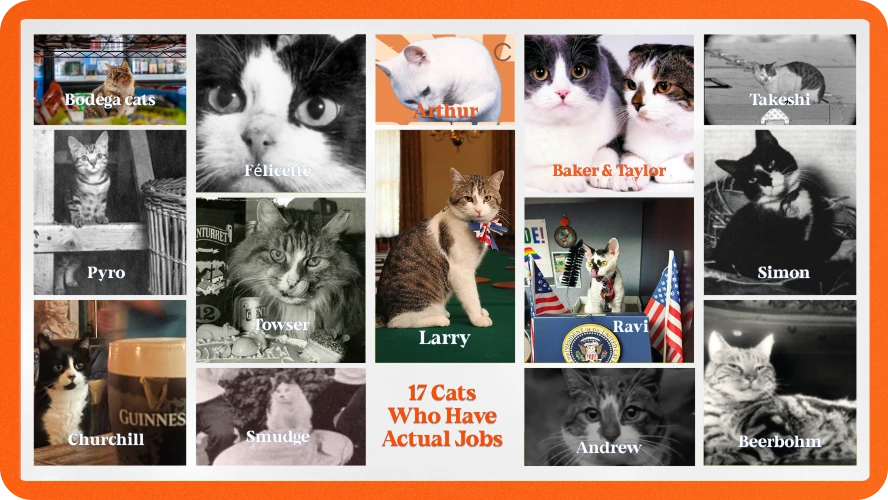
Cats have had a pretty interesting run when it comes to jobs. It started when humans had mice, and cats took care of them. But over time, their job changed quite a bit. Cats started working in libraries, theaters, post offices, pubs, museums, and even government buildings. One even went on an Antarctic trip, and another went to space. Some were officially brought in as mousers, while others became mascots or earned funny-sounding titles that, believe it or not, were real. Then there were those cats that just showed up often enough that everyone decided they were part of the team.
Here are 17 cats with actual jobs, or at least something really close to it.

1. Beerbohm, the theatre cat
Mouser and unofficial cast member • Gielgud Theatre, London
Beerbohm was actually hired as a mouser at London's Gielgud Theatre, and he did that job really well. But that’s not what he’s known for.
He seemed to treat the stage like just another part of the building, like a hallway or a dressing room. During a revue in 1976, he just strolled onstage without any cue or hesitation, and no one really knew why he was there. The audience spotted him, the actors did too, but nobody stopped him.
He remained at the theatre for about two decades before retiring in 1991. When Beerbohm passed away in 1995 at the age of 20, The Stage honored him with a front-page obituary that read: "Popular theatre cat loses his ninth life."
→ Read more about Beerbohm
2. Larry, the Downing Street cat
Chief Mouser to the Cabinet Office • 10 Downing Street, London
Out of all the quirky job titles on this list, Larry's is definitely legit. He showed up at 10 Downing Street in 2011 with the official title of Chief Mouser to the Cabinet Office. His job description includes greeting guests, checking out security, and giving antique furniture a test snooze. And let’s not forget the whole mouse situation; it's part of the deal.
While prime ministers have come and gone, Larry has stuck around. His presence has made him more than just a typical government mouser. He hangs out by one of the most photographed doors in the world, interrupts TV broadcasts, and sometimes gives journalists something to write about when there's not much going on in Westminster.
→ Read our interviewe with Larry the cat
3. Félicette, the cat who went to space
Space research cat • The French space program
Most cats aren’t really meant to go to space for work. But back in the early '60s, French researchers acquired 14 female cats for a space research program. One of them was a little tuxedo cat named C 341, who later got the name Félicette.
On October 18, 1963, they launched Félicette into the sky aboard a Véronique rocket. She spent about 13 minutes up there on a suborbital flight while the researchers checked out her heart rate and breathing. Fortunately, she made it back safe and sound.
Félicette ended up being the first and only cat to make a space trip and come back, even though her story didn’t get as much attention as other space animals like Laika for a long time.
→ Read Félicette's story
4. Ravi, the Pennsylvania Capitol cat
Office cat • Pennsylvania State Capitol
Ravi doesn’t have any official government title, a legislative role, or a say in budgeting, but a few days a week, this seven-pound cat tags along with Pennsylvania state Rep. Jessica Benham to work.
He’s got a pretty chill routine in Room 219, hanging out by the window to watch the hallway, saying hi to visitors, convincing people to join in on some playtime with his feather toy, and soaking up all the love from lawmakers, staff, and guests alike.
Rep Benham told us, “He gets more visitors than I do,” which makes Ravi either an office cat or a super clever way to connect with constituents.
→ Read our interview with Rep. Jessica Benham, Ravi's mom
5. Smudge, the museum cat who joined a trade union
Museum mouser • People's Palace, Glasgow
Smudge showed up at Glasgow's People's Palace to take care of the rodent situation, but pretty soon, she was way more famous than just being a mouser. Everyone around the museum knew her, and she even became a bit of a local celebrity. At one point, there was a big fuss when they tried to keep her out of the General, Municipal, Boilermakers and Allied Trades Union. The whole push for her to join turned her into the most famous trade union cat in the UK.
By the late '80s, Smudge was such a big deal in Glasgow that a potter named Margery Clinton even made ceramic figurines of her. Then came all the Smudge merch: postcards, mugs, notebooks, T-shirts, and fridge magnets started flying off the shelves, and they ended up raising enough cash to buy the museum a new word processor.
→ Read more about Smudge
6. Pyro, the flying cat
Flying mascot • Royal Air Force test flights
During World War II, Royal Air Force photographer Bob Bird sometimes took a tabby cat named Pyro to work, tucked inside his flight jacket. Pyro flew at around 20,000 feet while Bird and the crew tested weapons and gear in freezing, unpredictable conditions over the Atlantic. The guys thought he brought them good luck, but he also gave them something even more valuable: comfort. On one really cold flight, Bird's hands got dangerously numb, but Pyro’s body heat helped warm them up again. There are definitely easier ways for a cat to be considered a workplace mascot.
→ Read more about Pyro
7. Andrew, London's air-raid cat
Mascot-in-Chief and unofficial early-warning system • Wartime London
Andrew weighed about 14 pounds, with white socks and a distinctive V-shaped marking on his nose. Most of the time, he was just napping.
This was a bit of a problem since he was living through the London air raids during World War II. But Andrew had one peculiar habit. Just before certain flying bombs were about to drop nearby, he would get up and take cover. People around him quickly learned to follow him. If Andrew decided it was time to duck for cover, it was probably a smart move to follow him.
He later became Mascot-in-Chief of the PDSA's Allied Forces Mascot Club, which honored animals that were part of the military and Civil Defense teams. That title sounded impressive, but being able to get people to follow a cat into safety was probably even more impressive.
→ The story of Andrew, London's air-raid cat
8. Churchill, the pub cat
Pub cat • The Old Eagle, London
Churchill's job isn't exactly demanding. “He spends his days telling us to open doors, give him treats,” the team at the Old Eagle Club told us. He prefers his water fresh, cold and, if possible, served in a wine bucket. His working day also involves “a lot of sleeping, sitting with young ladies, smacking anyone when he's grumpy.”
Churchill has also been a fixture at the pub for ages. Every workplace has that one person who’s been around long enough to make their own rules.
→ Read more about Churchill
9. Gardenia, the Louisiana library cat
Library mouser, later general library assistant • Ouachita Parish Library, Louisiana
Gardenia was brought into a Louisiana library to do a pretty standard job: take care of the rodents. And she nailed it. But instead of just sticking to that, she got the second job.
Gardenia started hanging out with the kids who visited the library and didn't mind being carried around by them. During film screenings, she’d chill next to them and watch the movies. Adults doing research sometimes found themselves with a cat in their lap. Whenever new books arrived, she made sure to give them her own thorough inspection, mostly by sitting right on top of them.
The rats were gone, but Gardenia had no plans of stopping her library job.
→ The story of Gardenia
10. Baker and Taylor, the library cats who went into marketing
Mousers and library spokes-cats • Douglas County Public Library, Nevada
Baker and Taylor started out like a lot of working cats: they were brought into a small-town library to help keep the pests in check. But then someone had the idea to put them on a poster.
These two Scottish Folds turned out to be pretty great at that job too. Photos of them were used to promote the library, and what started as a simple local marketing idea ended up taking off way beyond Nevada. Their posters popped up in libraries all over the country, and Baker and Taylor became well-known faces in the library community. They went from being pest control kitties to marketing stars. Talk about a career change before LinkedIn was even a thing.
→ Read more about Baker and Taylor
11. Takeshi, the cat who went south
Expedition mascot • Japanese Antarctic Research Expedition
In 1956, a male calico cat named Takeshi hopped on the research ship Sōya with Japan's first Antarctic observation team.
Takeshi wasn’t there for any scientific purpose; he was more like the expedition's mascot. His presence brought some comfort to the crew on their journey to such an unfamiliar place. They associated him with good luck and hoped he'd help them make it back home safely.
→ The story of Takeshi
12. The bodega cats of New York
Shop cats • New York City bodegas
At New York City's bodegas, you'll find cats chillin' behind counters, lounging on shelves, hanging out next to grocery stacks, and sometimes right where a customer is trying to stand. They're bodega cats.
Dan Rimada has spent years documenting them. His book, "Bodega Cats of New York," tells the stories of the stores and people around them, showing a working-cat tradition that's been around long before social media came along.
→ Read our interview with Dan Rimada
13. Simon, the Able Seacat
Ship's cat • HMS Amethyst
Simon served aboard the Royal Navy ship HMS Amethyst, where one of his most important responsibilities was keeping rats away from the crew's food supplies.
In 1949, Amethyst came under heavy fire on the Yangtze River. Simon was badly wounded but survived and got back to work. One of the challenges he faced was a pesky rat that the crew had jokingly named “Mao Tse-Tung.” At first, the sailors thought Simon was too weak to handle it, but he proved them wrong and took care of the problem.
His efforts in keeping the rat situation under control and providing comfort to his crew earned him the Dickin Medal. He remains the only cat ever to receive it. The crew also promoted him to “Able Seacat Simon.”
→ The story of Simon the ship's cat
14. Arthur, the television cat
Television advertising cat • British television
Arthur's career was built around one very simple trick: he'd scoop food from a tin with his paw. It became one of Britain's most recognizable television images.
He starred in ads for the cat-food brand that eventually adopted his name, turning this white cat with dark spots into a beloved fixture of the British TV scene in the 1960s. Most TV hosts have to go through a lot more training than that.
→ The story of Arthur and some weird drama
15. Tibs the Great, Britain's Post Office cat
Post Office mouser • London Post Office HQ
Tibs had a proper government job. For 14 years, the tabby worked at the Post Office headquarters in London, where there was so much paper and mail that keeping rodents away was a real challenge.
Cats had long been employed by the Post Office to tackle the mouse problem, and Tibs became the most famous mouser. He reportedly kept the building mouse-free during his tenure and earned the title of Tibs the Great. And unlike some of his feline counterparts, Tibs actually got paid for his work. Finally, a cat with payroll paperwork.
→ Read more about Tips the Great
16. Towser, the world's greatest mouser
Distillery mouser • Glenturret Distillery, Scotland
Towser was probably the most impressive cat around when it came to work performance. This long-haired tortoiseshell was the resident mouser at Scotland's Glenturret Distillery, where the stores of barley were like a magnet for the kind of pesky visitors no distillery wanted.
Throughout her long career, Towser built quite the reputation for her hunting skills. Guinness World Records even recognized her for catching around 28,899 mice over 24 years.
Now, there’s a statue of her at the distillery. Good luck getting that kind of recognition with an Employee of the Month award.
→ Read more about Towser
17. Minnie, the stadium cat
Stadium mouser • White City Stadium, London
There was a big stadium in London, White City Stadium, that could fit tens of thousands of people, and it also had a little employee named Minnie. She was a cat, and her job was to keep the place free of rats. It was basically pest control, but it meant that this cat was hanging out in one of the biggest sports venues while all those people came and went.
According to the 1975 edition of the Guinness Book of World Records, Minnie killed 12,480 rats at the stadium over a 6-year period from 1927 to 1933.
→ The story of Minnie
So obviously mice are the main issue here. For centuries, people have stored grain, food, paper, and all sorts of things rodents love, and cats have been great at keeping those little troublemakers under control. That’s why you’d find working cats in places like breweries, libraries, ships, post offices, stores, theaters, and stadiums.
But the jobs never really stayed that simple. A mouser might become a star in a theater. Two library cats ended up in the marketing team. A museum cat even joined a union. One shop cat became a staple of the neighborhood. Ravi mostly welcomes visitors, while Churchill seems to have landed a pretty sweet deal with his own staff.
Maybe that’s why cats have stuck around in human workplaces for so long. They were brought in to do a job, but somewhere between the mice and the afternoon nap, they became part of the place.
If you’re interested in more stories like these, explore the full collection: Cats with jobs.
Share this story
More stories
Furrend circle
Be the first one to hear about updates
