
April 27, 2026
Rossetti and the Wombat
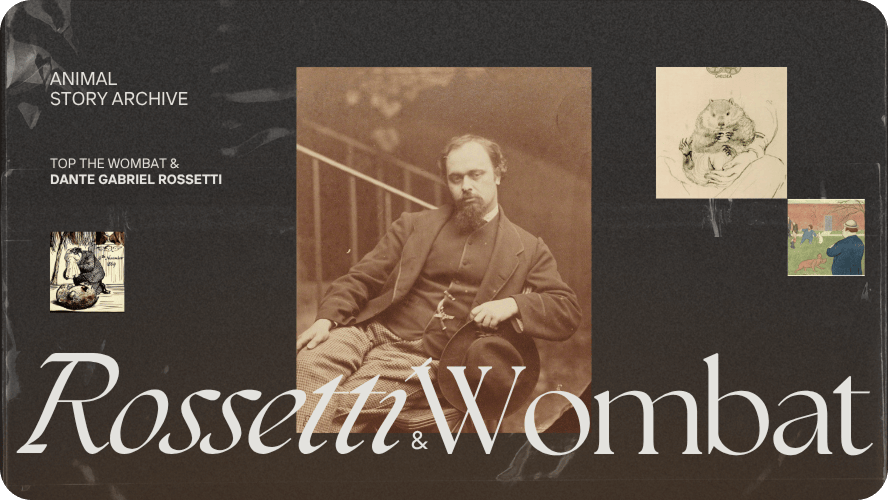
In 1869, poet Dante Gabriel Rossetti brought a wombat named Top into his London home, where he wandered among artists, interrupted conversations, and briefly became part of Victorian literary life.
In 1869, in a London house already full of painters, poets, and visitors with strong opinions, and a garden with exotic birds and animals, there was also a wombat following people from room to room.
The Chelsea house belonged to Dante Gabriel Rossetti, who had been thinking about wombats for some time. Years earlier, he had seen one at the London Zoo and found the idea difficult to let go. In a letter to Jane Morris, the wife of his friend William Morris, he wrote, “Can peace be gained, until I clasp my wombat!” He could hardly wait to return to London from Scotland to see his newly acquired companion. Later, writing to his brother William Michael, he described the animal as “a joy, a triumph, a delight, a madness.”
He named the wombat Top, after Morris, whose nickname “Topsy” seemed to suit the occasion well enough.
Top settled into his new home without hesitation. He followed guests from room to room, appearing without invitation and without any sense that one might be required. Conversations were held in his presence, though not always uninterrupted. Guests such as John Ruskin and Algernon Charles Swinburne would arrive expecting an evening of conversation and instead find themselves accompanied by a small, persistent creature with his own ideas about proximity.
At least once, a carefully sustained monologue by Ruskin was brought to a stop when Top made his way between a guest’s jacket and waistcoat. No one seems to have suggested that this was inappropriate.
Top also developed an interest in objects. On one occasion, he ate part of a guest’s hat. Rossetti’s concern was not for the hat, but for whether it might upset Top’s stomach.
Top held a remarkable place among Rossetti and his circle. He was mentioned in conversation and later appeared in drawings and poems. There is something faintly improbable about it even now: a Victorian sitting room filled with talk of art and literature, and a wombat passing steadily through it, or seated in Rossetti’s lap, as if this were the most natural thing in the world.
But it did not last.
Only a few months after arriving, in November of 1869, Top died. Rossetti responded in the way he understood best and wrote a short poem, beginning with a familiar sense of loss:
I never nurs’d a dear gazelle. To glad me with its soft black eye, but when it came to know me well. And love me, it was sure to die!

Top was later preserved and kept in the house, a decision that feels entirely consistent with everything that came before it. Rossetti tried again with another wombat, but that one did not last long either. It seems London was not built for animals like this.
Still, for a brief period, in a house crowded with ideas and people who wrote them down, a wombat moved through the rooms as if he belonged there. And for a while, he did.
Share this story
Animals with jobs
More stories
Furrend circle
Be the first one to hear about updates
