
May 14, 2026
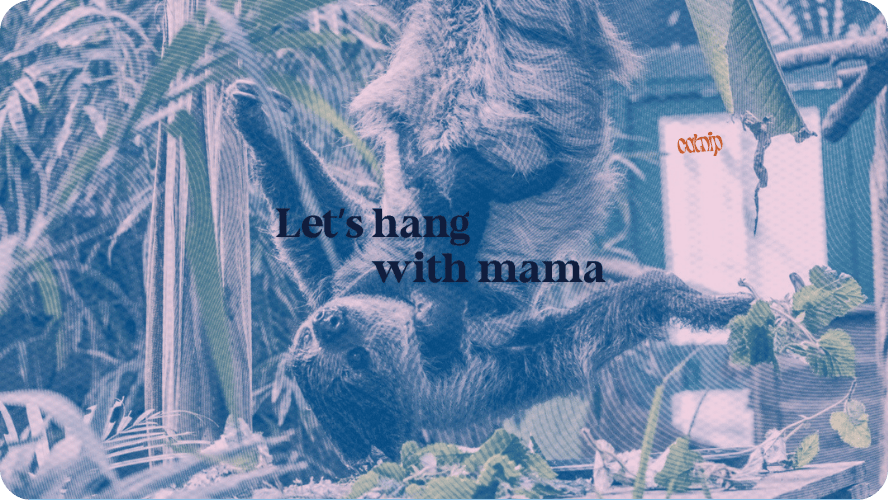
Let's hang with mama
Internet’s mamaposting obsession.
There was news from Scotland this week: a baby sloth has been born at the Edinburgh Zoo, the first ever born in Scotland. The zoo shared photos of the newborn, now named Atty after Sir David Attenborough, clinging upside down to its mother like a tiny piece of Velcro. Almost immediately, the replies filled with variations of the same joke, “let’s upside down with mama,” “let’s hang with mama.”
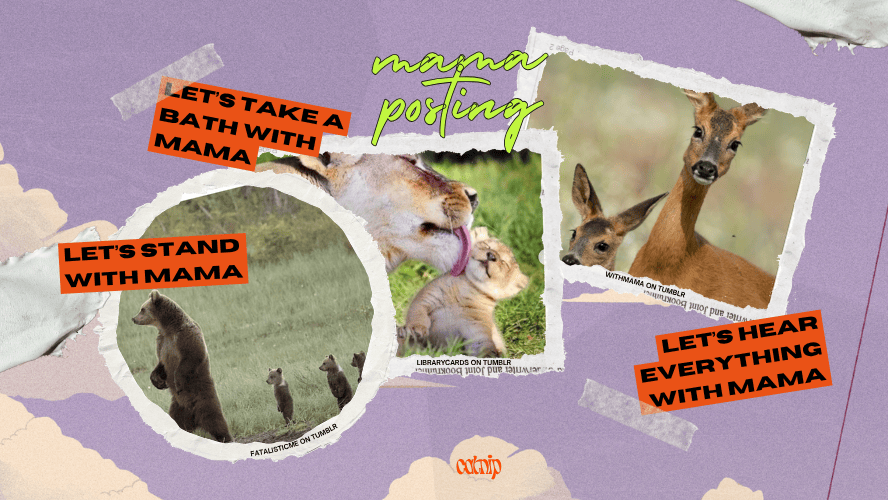
The internet has seen plenty of animal memes over the years, but mamaposting occupies a very specific corner of online culture, somewhere between sincere affection, Tumblr-era absurdism, and collective emotional regression. The format is deceptively simple: a smaller creature beside a larger one, captioned with phrases like "let’s glow serenely with mama," “kissy from mama,” or “my luminous mama.” Sometimes the captions describe an action. Sometimes they barely describe anything at all. The point is less the joke itself than the feeling surrounding it.
The original mamaposts first appeared on Tumblr more than a decade ago, but the format exploded back into wider internet consciousness last summer after users began reviving and remixing older posts under the hashtag "#mamaposting". The post most commonly credited as the spiritual origin of this genre originally came from Tumblr user mysterypuppy in January 2025. It featured a gif of the solar system captioned, "let’s orbit around mama."
Just five words, and somehow an entire emotional ecosystem snapped into place. The sun was mama, the planets were safe, and nothing else needed to be explained.
From there, the format spread in the slow, accumulative way Tumblr trends often do, less like a viral TikTok sound and more like people collaboratively building a scrapbook. Users kept discovering increasingly perfect images of creatures existing near larger, wiser creatures: a baby beluga drifting beneath its mother with the caption “let’s glow serenely with mama,” two black cats baring identical tiny vampire teeth under "let’s be vampire with mama," a mother chicken shielding her chicks beneath the line "curled up with mama… protected by mama… let’s be warm with mama…"
The captions themselves sound strangely ancient and childlike, like fragments of language reconstructed after civilization collapsed, but everyone still remembered how comfort worked.
Tumblr has always had a unique relationship with sincerity. Most modern internet platforms train users to flatten every emotion into irony, branding, or performance, but Tumblr still allows people to feel something directly, especially if that feeling arrives disguised as an animal. You are not posting "I want safety." You are posting a baby cheetah sitting beside its mother and writing, "let’s observe with mama." It's close enough.
Part of what makes mamaposting feel so distinctly Tumblr is its pacing. The posts are image-heavy, text-light, and strangely patient. Nobody explains the joke because the joke barely exists in the first place. Nobody is building lore, optimizing for engagement, or filming reaction videos about the deeper meaning of mama. People just keep finding photos where one creature appears smaller, softer, or emotionally dependent on another creature, and everybody else immediately understands it.
By last summer, the meme had already broken containment, escaping Tumblr and spreading onto Reddit compilations and repost accounts, which is usually the final stage of any Tumblr ecosystem before the rest of the internet notices it exists. Some users reportedly turned off reblogs on popular mamaposts because the notifications became overwhelming, an extremely Tumblr-specific problem that feels almost nostalgic on its own. Your phone is exploding because 40,000 strangers became emotionally attached to a baby beluga whale, not because somebody is angry at you.
And the timing of the meme’s resurgence probably is not accidental. The internet has spent the past several years trapped inside an endless cycle of overstimulation, algorithmic rage, economic anxiety, political collapse, AI panic, and increasingly aggressive content optimization. Even nostalgia online has become industrialized, flattened into aesthetics and recycled trends delivered through recommendation engines. Mamaposting feels different because it asks almost nothing from the viewer. There is no discourse attached to it, no fandom war, no creator economy strategy, and no layered irony requiring fifteen years of context to decode. Just small creatures wanting proximity to something warm and safe.
In that sense, mamaposting feels strangely adjacent to the return of recession pop, the recent wave of glossy 2010s dance music soundtracking TikToks while headlines describe layoffs and geopolitical collapse. Tumblr users describing mamaposting as “2012-coded” are not really talking about the year itself. They are talking about remembering an internet that still felt inhabited by people instead of systems, where your dashboard became consumed by thousands of users collectively deciding that a baby otter kissing its mother was the most important image online for 48 hours. And Tumblr, despite everything, still feels capable of producing that kind of collective softness.
There is also something fascinating about how quickly the meme became mammalian. Even when the original “mama” was literally a star at the center of the solar system, users instinctively translated the format toward animals, care, warmth, and protection. Mammals curled against mammals. Creatures sheltering smaller creatures. The language itself softens into something instinctive. Mama, not mother, not parent, just mama.
The word matters because it transforms the meme from observation into longing. You are no longer looking at wildlife photography, and now you are participating in a small emotional fantasy where something larger and warmer exists nearby, and maybe that is enough for today. And honestly, it might explain why the meme spread so quickly in the first place.
Because in these deeply exhausting, spiritually buffering times, maybe we all just want to orbit around mama for a little while.
Share this story
