
October 17, 2026
Sinbad, the Flying Ace's Lucky Cat
A stray black cat became the companion of an American fighter pilot during World War II, and a good luck charm for his squadron.
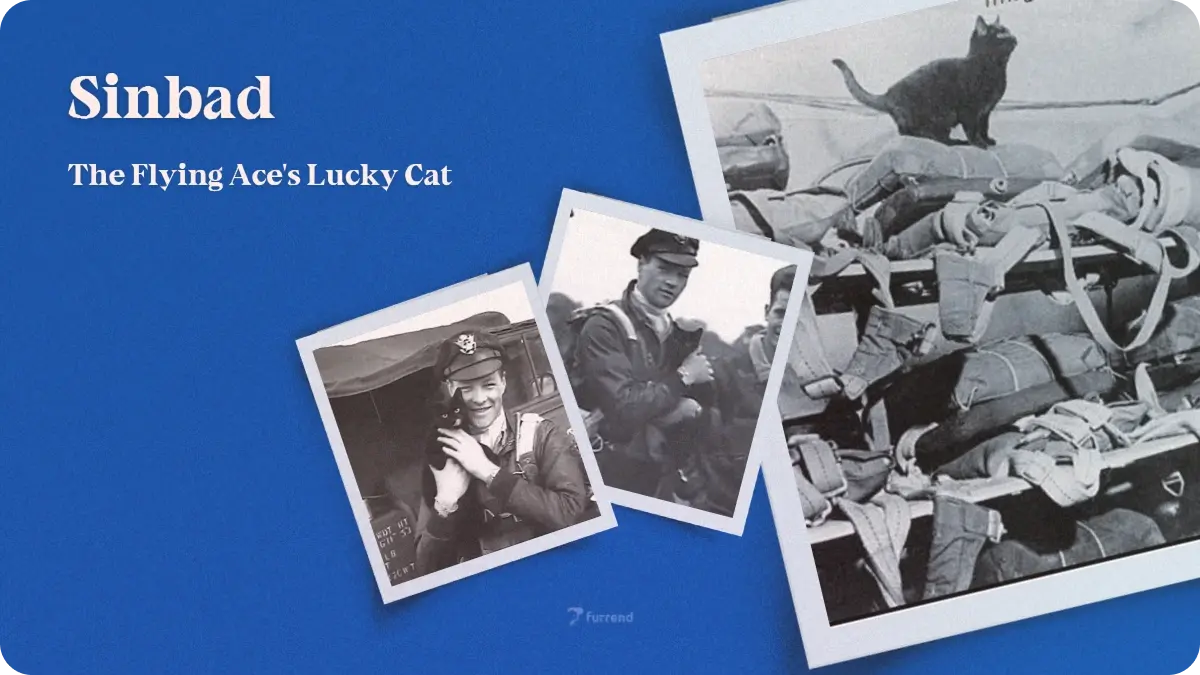
During World War II, American fighter pilot Fred Christensen found a stray black kitten while he was stationed in England and decided to keep the kitten. He named the cat Sinbad.
Christensen flew P-47 Thunderbolts with the 56th Fighter Group of the U.S. Army Air Forces, which was known as the Wolfpack. He became one of the group's leading flying aces, credited with shooting down six German aircraft in a single engagement in July 1944.
What made his story even more interesting was his unusual companion. According to accounts of his wartime service, Sinbad sometimes accompanied him in the cockpit, and he thought the cat was his good luck charm. The other pilots soon had their own reasons to see Sinbad as a lucky cat too.

A little luck in the parachute store
On November 26, 1943, Sinbad was found wandering around the squadron's parachute store. When the pilots tried to chase the cat out, Sinbad jumped from one packed parachute to another. According to the 56th Fighter Group's historical account, every pilot whose parachute the cat touched scored an aerial victory that day.
It was quite a crazy coincidence, and the pilots definitely noticed. Instead of keeping Sinbad out of the parachute store, they gave the cat a place to stay. One of the pilots, Schilling, reportedly provided a comfortable pillow and a saucer of milk. That's how Sinbad earned a reputation as the squadron's lucky cat.
Sinbad and Christensen
Sinbad also attracted the attention of wartime photographers. On July 13, 1944, Captain Arthur W. Bartholomew from 3rd AAF Intelligence filmed Christensen at the airfield shortly after his celebrated six-victory mission. The footage shows him holding and playing with a black cat believed to be Sinbad.
Fred Christensen with Sinbad, July 1944 · British Pathé
Christensen's daughter, Diane Haagensen, later recalled that her father's safe return with his feline companion helped lift other pilots' spirits. After his combat tour wrapped up in September 1944, he brought Sinbad back home to the U.S.
It turned out that Sinbad was actually a female when she gave birth to kittens, something the family found out later. She lived with them until the early 1950s, when she sadly got hit by a car. But by then, Sinbad had already made quite a name for herself. She was a stray kitten who found a home among fighter pilots, a place to sleep in the parachute store, and a reputation for bringing people home safe.
More of the wartime-cat trail that led here lives on Purr 'n' Fur.
Share this story
Animals at war
More stories
Furrend circle
Be the first one to hear about updates
