
October 6, 2026
The Animals Who Went to Space
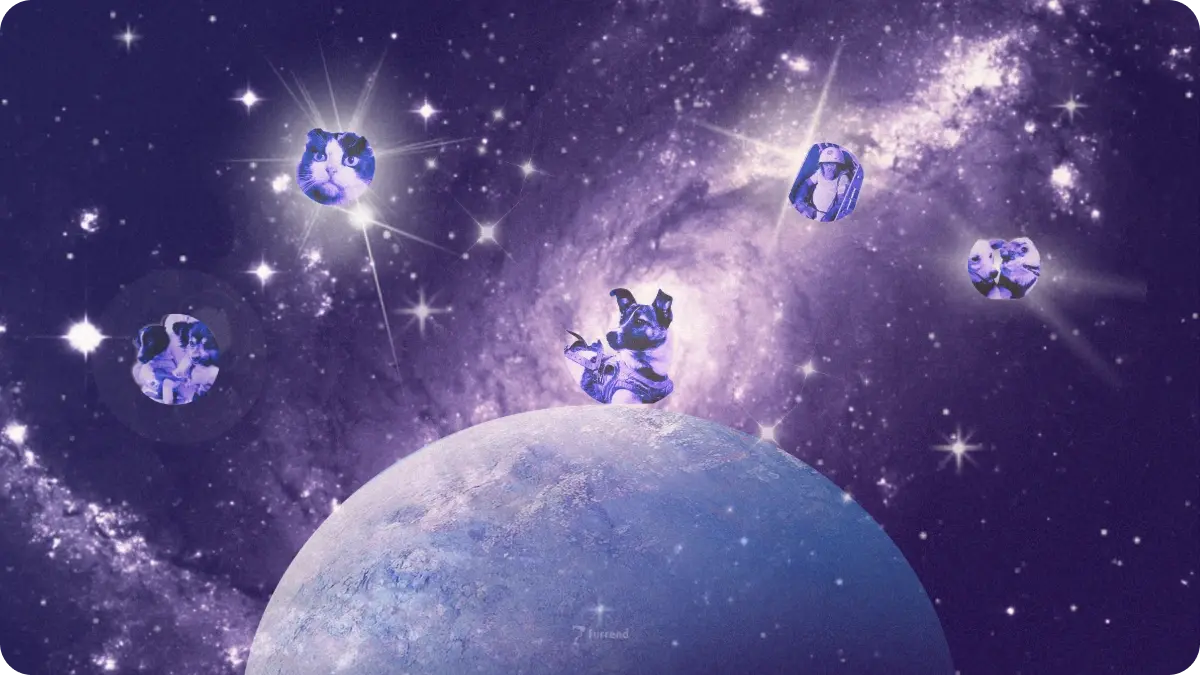
Before humans went to space, animals like dogs, cats, and monkeys had already made the trip.
By the 1950s, countries were figuring out how to send people into space. Before they could do that, there were some fairly basic questions to answer. Could a living being survive a rocket launch? What would it be like without gravity? Would everything function normally up there, and could they come back?
Animals became part of the attempt to find out. Some flew for just a few minutes, while others spent days or weeks in orbit. Some made it back home and lived on for years, while others were sent on missions with no plans to return. There were dogs, monkeys, and a cat. Interestingly, two tortoises actually orbited the Moon before any humans did. Once people started going into space, animals didn’t stop either; the focus just shifted a little.

The dogs before orbit
Laika is probably the most famous space dog, but before she went to space, dogs had already been taking rides on rockets for a while. Back in the early 1950s, the Soviet space program began sending dogs on short flights high into the atmosphere, usually in pairs. They often chose small female dogs, many of them strays from the streets of Moscow, because they were the right size and seemed tough enough to handle rough conditions.
In July 1951, two dogs named Dezik and Tsygan flew together and reached about 100 kilometers up before their capsule came back down safely. Both returned in one piece.
The space travels continued, although not every dog was so lucky. Sometimes, things went wrong even before liftoff. In 1951, a dog named Bobik escaped just before his flight, so the team found another dog wandering near the institute's canteen and recruited her instead. They called her ZIB, an acronym that meant “Substitute for Missing Dog Bobik.” ZIB went to space while Bobik apparently had other things to do.

Laika and Sputnik 2
Six years later, the goal was no longer simply to send a dog up and bring them back down. The Soviet Union had already made history by launching Sputnik 1, the very first artificial satellite, back in October 1957. Just weeks later, they were prepping for another mission, and this time, a passenger would be onboard.
Laika was a small mixed-breed dog found roaming the streets of Moscow. Before the flight, she and some other dogs were trained for what they’d face in the spacecraft. They spent time in tiny enclosures and got used to the loud noises and forces of a rocket launch.
Laika was chosen for Sputnik 2, which blasted off on November 3, 1957. She became the first animal to orbit the Earth, with sensors tracking her breathing, heart rate, and movement as the spacecraft flew around the planet. Unfortunately, there was no plan to bring her back home.
The spacecraft had been built without a recovery system. Initially, Soviet officials claimed Laika survived for several days, but many years later information revealed she actually died just a few hours after the launch due to overheating in the cabin. Sputnik 2 kept orbiting for another five months before it burned up in Earth’s atmosphere.
Laika spent only a few weeks in the Soviet space program, but she made a lasting impact. Her image eventually appeared on stamps, postcards, and monuments, making her one of the most famous animals in spaceflight history.
Read: Laika the Dog →
Belka, Strelka, and Sputnik 5
By 1960, another pair of dogs was prepared for a very different mission. Belka and Strelka spent months training, learning to eat gelatinous space food, get used to tight quarters, and wear the suits and gear they'd use during their flight.
On August 19, they boarded Sputnik 5. They weren't alone. The spacecraft also carried a rabbit, dozens of mice, rats, fruit flies, plants, and other biological samples, turning the capsule into a small orbiting collection of life from Earth.
Belka and Strelka spent more than a day in space, circling the planet 17 times. Researchers on the ground watched them through cameras during the flight. Belka became visibly agitated and vomited after several orbits, which later made people reconsider how long humans should stay in orbit. Finally, Sputnik 5 returned. The capsule landed the following day, and both dogs were alive.
After that, they became pretty famous. The two pups were in newspapers, on postcards, stamps, and all sorts of souvenirs. Strelka later had six puppies, one of which would go on to have a very famous address.
In 1961, Nikita Khrushchev gifted a pup named Pushinka to Caroline Kennedy. Pushinka moved into the White House, where she later had four puppies with one of the Kennedy family dogs, Charlie. John F. Kennedy jokingly called the puppies “pupniks.”
So, just three years after Laika went to space with no way back, another Soviet space dog went up, returned home, started a family, and somehow ended up with descendants running around the White House.
.jpg)
Ham and Mercury-Redstone 2
Across the Atlantic, another animal was undergoing some unique training. Ham was a young chimp who’d been brought from Africa to the US and trained at Holloman Air Force Base in New Mexico. Using lights as cues, he learned to pull levers at the right time and got rewarded with banana pellets when he did it correctly.
The goal wasn’t just to see if a chimp could survive a space flight. Researchers wanted to find out if he could still perform tasks while experiencing launch, weightlessness, and reentry.
On January 31, 1961, Ham was strapped into a Mercury capsule and launched aboard Mercury-Redstone 2. The flight didn't go entirely according to plan. The rocket traveled higher and farther than expected, and Ham felt stronger forces during reentry than they thought he would, but he kept responding to the signals throughout the flight. About 16 minutes after takeoff, his capsule splashed down in the Atlantic. Ham made it back.
A little over three months later, Alan Shepard flew aboard another Mercury-Redstone rocket and became the first American in space.
Ham didn’t fly again after that. He spent the rest of his life at the National Zoo in Washington and later the North Carolina Zoo, where he passed away in 1983.

Read: Ham the Astrochimp →
Félicette and Véronique
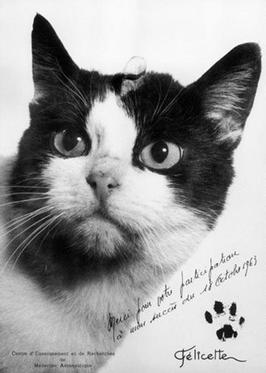
By 1963, humans had already reached space, but animals were still part of the experiments. France had begun its own biological rocket experiments, first with rats and then with cats. The cats were trained for the conditions of flight and implanted with electrodes that allowed researchers to monitor their brain activity. One of those cats was Félicette.
On October 18, 1963, she was launched from Hammaguir in the Algerian Sahara on a Véronique rocket. Unlike Laika's orbital flight, Félicette's trip was short and suborbital. The rocket climbed to an altitude of more than 150 kilometers before the capsule separated and came back down with a parachute. Félicette made it back alive. Her flight lasted only about 13 minutes, but it made her the first cat to go to space and return.
She lived for another two months before researchers euthanized her so they could examine her brain and study the effects of the flight.
For decades, Félicette was far less famous than Laika or Ham, and sometimes her photos were mixed up with a male cat named Félix. In 2019, a bronze statue of Félicette was revealed at the International Space University in Strasbourg, where she sits on a globe, gazing up at the sky.
Read: Félicette the Cat Who Touched Space →
Veterok and Ugolyok's 21 days
Early animal flights had lasted minutes or hours. By the mid-1960s, researchers wanted to know what happened when a body stayed in space much longer. In February 1966, two dogs named Veterok and Ugolyok were launched aboard Kosmos 110. They stayed there for 22 days.
Humans had already spent days up there too, but sending the dogs into space gave researchers a chance to see how long-term spaceflight affected their bodies. When Veterok and Ugolyok finally made it back to Earth, they were weak, had lost some weight and muscle, and their fur was thinning in spots where gear had rubbed against them. Luckily, they both recovered.
They set the record for the longest dog spaceflight, and no one ever broke it. And the era of sending dogs into orbit was coming to an end.

The tortoises aboard Zond 5
In 1968, two tortoises went somewhere no animal from Earth had gone before. They orbited the Moon. The Soviet spacecraft Zond 5 launched in September carrying two steppe tortoises, along with fruit flies, mealworms, plants, seeds, and other biological material. There were no humans aboard.
Zond 5 traveled away from Earth, passed around the Moon, and began the long journey home. After almost seven days in space, the capsule reentered Earth's atmosphere and landed in the Indian Ocean. The tortoises were alive. They did lose a bit of weight but remained active, and later tests showed they were pretty much the same as tortoises that stayed on Earth.
Three months later, Apollo 8 carried Frank Borman, Jim Lovell, and William Anders around the Moon, making them the first humans to make the same journey. Those tortoises really beat the humans to it.
Not every cat had to leave Earth
Animals weren't only riding rockets. Back on Earth, researchers were also using them to understand one of the strangest parts of space travel: what happens when there's no obvious up or down?
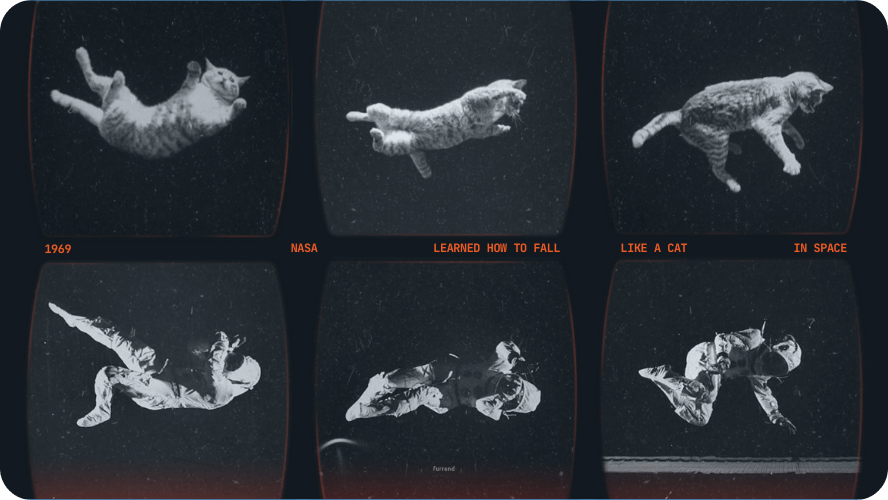
Cats presented an interesting case because they were exceptionally good at turning themselves in midair and landing on their feet. So, researchers began studying how cats managed this without pushing against anything. They put the cats through short bursts of simulated weightlessness and filmed what happened when the usual gravitational cues just disappeared.
The resulting footage is strange to watch. A researcher releases a cat into the air, and the cat twists around, trying to find a floor that just isn’t there. For a few seconds, it’s like one of the cat’s basic instincts vanishes. This research helps scientists figure out how humans might balance in weightlessness.
Read: The Year NASA Learned How to Fall Like a Cat →
Spiders, fish and everything after
By the 1970s, the focus had shifted. Humans had orbited Earth, spent time in space, walked on the Moon, and returned home. Scientists were no longer sending animals into space just to see if they could survive the trip. Instead, they began asking more specific questions about how life actually behaves when there's no gravity.
In 1973, two garden spiders named Arabella and Anita went to Skylab because a high school student proposed an experiment: could a spider still make a web in space? At first, it didn’t go so well. Without gravity, the spiders struggled to orient themselves, and their early webs were irregular. But they adapted, and their later webs looked a lot more like what you'd expect from spiders here on Earth.
Other experiments involved sending fish to see how they oriented themselves without the usual sense of up and down. Scientists used frogs and their eggs to check development in microgravity, and raised jellyfish in space to study how animals sense gravity.
Mice, insects, worms, and other small creatures continued making the trip too. The animals kept going up, but they were no longer being sent ahead to find out whether humans could. The questions changed. How does a spider build a web in zero gravity? How does a fish know which way is up? What happens to bones, muscles, cells, and developing organisms when they're not being pulled down by Earth’s gravity?
Those experiments continue today. Scientists sent the first animals up because humans had no clue what would happen to living beings there. More than 75 years after the first fruit flies left Earth, we're still learning new things.
Share this story
More stories
Furrend circle
Be the first one to hear about updates
