
August 8, 2026
Our Other Selves
Ricky Gervais' Alley Cats gives human problems to cartoon cats, and somehow makes them a little easier to look at.
"Life is a gift. And you're a cat. A cat! Do you know how good that is? To be a cat? It's fucking great."
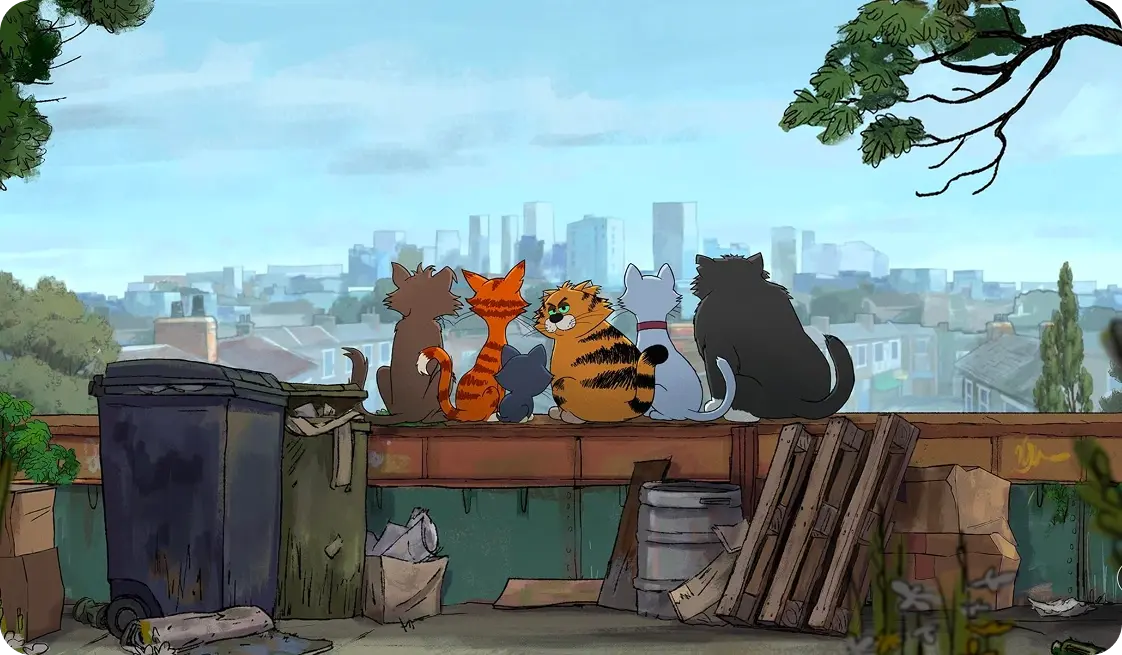
This is Gus talking to a kitten in Alley Cats, Ricky Gervais' new animated series about a group of feral British cats. They spend their days just wandering around, watching TV, meeting other cats, getting hungry, and talking about life while trying to help a lost kitten find her way home.
They're technically cats, but they start to feel a lot more relatable pretty quickly. The cats in Alley Cats worry about companionship. They get annoyed with one another. They experience jealousy, sadness, happiness, fear, grief, and sometimes an existential crisis. They say terrible things to their friends but can also be super sweet. And since it’s Ricky Gervais, they swear a lot too.
"How are we?" "Hungry, tired. Full of hate and fury." That feels like a conversation you might have with a friend after a long week. Give it to two animated cats instead, and suddenly it becomes funny.
Maybe that's part of why animals have always been so great for telling stories about ourselves. They give us a little distance. Jealousy looks different on a cat, and so does loneliness. Grief can become a bit easier to deal with when the person experiencing it has paws and a tail. Even the things we'd sound silly saying out loud can be surprisingly honest when it’s coming from an animal that was just thinking about food a second ago.
In The World Next to Ours, we talked about what it looks like when we stop trying to make animals fit our narrative and instead think about how they see us. Alley Cats does almost exactly the opposite. It puts us right in the minds of the cats. They reflect our other selves.
Of course, these aren't really cats. Real cats aren't hanging out on a couch in an alley, debating existence or whether they’re making the right choices, at least not in English. But there’s something relatable about using cats for this.
We've built quite a personality around them over the years. Cats are independent, judgmental, sometimes selfish, and loving only on their own terms while being obsessed with food. They can act like jerks but then curl up next to you as if nothing happened.
Give that animal a human voice, and you don't need to explain too much. They can say something mean, and we let it slide. They can be melodramatic, and it feels just right. A cat can claim that life sucks and then immediately get distracted by food. Both can be true at the same time. That’s what makes these characters so relatable. They show the messy parts of ourselves without needing to be perfect.
We invest a lot of feelings into animals in stories. We let them feel lonely for us, be a little selfish, say something harsh, or show our fears. And since they’re not exactly us, it’s easier to laugh. But that distance also helps us connect on a deeper level, letting some tenderness come through.
Beneath all the cursing and bickering in Alley Cats, there's a simple story: someone is lost, and a group of cats decides to help.
The lost kitten gives all that wandering and talking a purpose. These cats can complain about the world as much as they like, but at the end of the day, they have to figure out what they want to do. And they actually care. Maybe that's why Alley Cats reminds us a little of After Life. Not because the stories are somehow similar, but because Gervais seems to explore a similar theme: people can be angry, difficult, lonely, and rude while still finding reasons to care for one another. This time, those people just happen to be cats.
There is something almost ridiculous about Gus telling the kitten that life is a gift. The kitten doesn't need a philosophy of existence. She's a cat. But maybe that’s why the line hits home. Sometimes looking at ourselves directly is exhausting. We know too well why we’re unhappy, what could go wrong, and how the world has let us down. But when those feelings come from a cartoon cat, they feel smaller and easier to deal with.
A cat gets hungry, feels jealous, misses someone, or loses a loved one. Sometimes they find another cat and choose to stick together. We probably see ourselves in animals because we’ve been around them for so long. Or maybe we project our feelings onto them because it’s easier to think about our emotions when we’re looking at them from a safe distance.
Either way, Gus has a point. Life is a gift. You get to be here. And if you're a cat? It's fucking great.

Share this story
