
September 7, 2026
What Can Data Tell Us About Our Cats?
Sarah from Moggie on what cat data can tell us, what it can't, and why knowing your own cat still matters.
Live with a cat long enough, and you start picking up on the little things. Like when they change their favorite sleeping spot or when there’s less food in the bowl than usual. You might have a hunch that your cat is snoozing more than before, even if you can’t quite figure out when that started.
After spending time together, you begin to get a sense of what’s normal for them. Well, sort of. It's not always easy to remember exactly what happened and when, and cats are pretty good at keeping their little secrets. Sometimes, all we can say is that “something feels off.” And that’s where things get interesting when you have some data to look at.
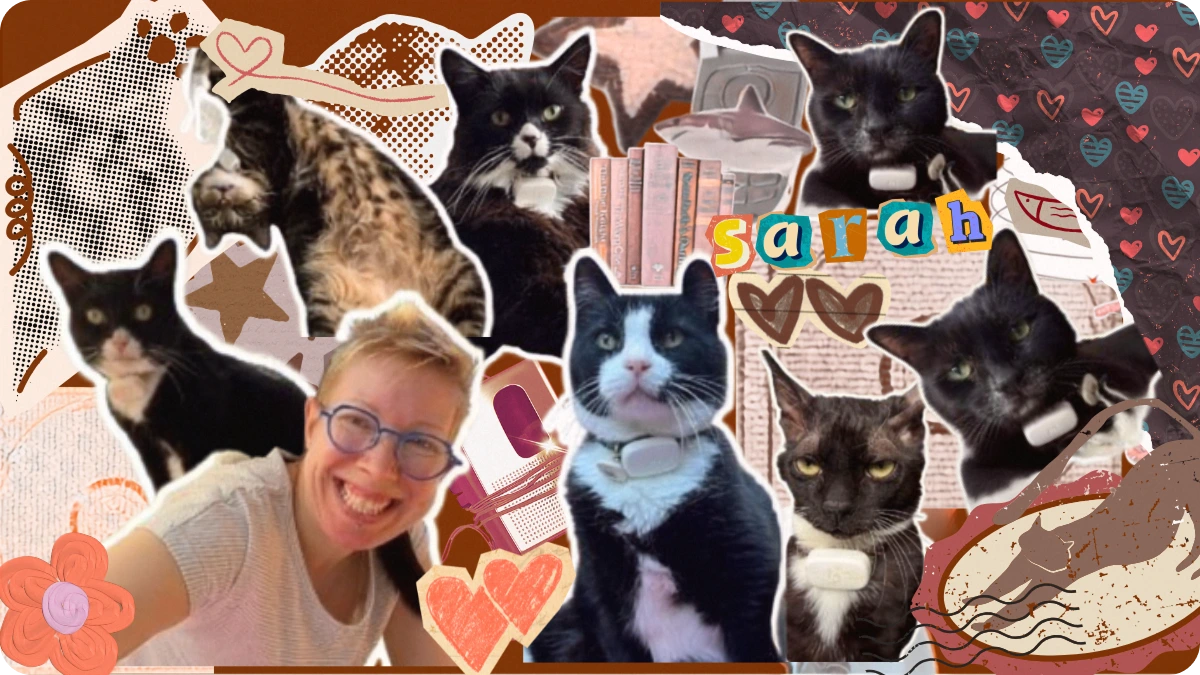
Sarah Irving from Moggie has a full house with seven cats, ranging from about 18 months to 19 years old. Living with seven very different personalities has taught her to notice the subtle ways each cat communicates. Her work with Moggie has added another layer to that: putting data behind some of the things cat people already notice.
We talked to Sarah about what happens when you back your instincts with data, what cats get up to when we’re not around, and whether technology can really help us understand them better.

Living with seven cats
I have quite the clowder! My eldest has just turned 19 and my youngest is around 18 months, so there’s a real mix of ages and personalities in the house.
I’m very lucky that, through very slow and purposeful introductions - always led by the cats - they generally get on really well. Of course, there are the odd disagreements, as you’d expect with any group, but for the most part they genuinely seem to enjoy each other’s company.
Having so many different cats has taught me how individual their ways of communicating are. I’ve become very aware of slight shifts in their demeanour, routines and habits.
Charlie, for example, was a long-term stray before I adopted him and had survived for around five years on the streets with a badly broken leg. Because of those experiences, when he’s experiencing pain or feeling unwell, his instinct can be to withdraw. I’ve learned to notice those subtle changes, as well as little differences in things like his eating habits.
They all have their own quirks and their own ways of telling me how they’re doing. Moggie adds another layer to that. It can help me spot changes or patterns that might otherwise go unnoticed, even when I’m a pretty attentive cat parent.

Putting data behind instinct
Cat parents really are an observant bunch! I think one of the most valuable things about putting data behind those instincts is that it gives you something more tangible to work with.
It’s very easy to think, “Am I overreacting?” or “Has that actually changed, or am I imagining it?” Data can give you additional context and help you identify patterns that are really difficult to recognise from observation alone.
That can also be useful when you're talking to your vet. Rather than trying to remember exactly what happened over the past few weeks while you’re sitting there with a stressed cat, you have information to refer back to.
Moggie has definitely changed how I understand my own cats too. One of my favourite discoveries was that Sam tends to play much more in the evening than at other times of day (usually when I am cooking and she has disappeared upstairs). It’s a small insight, but it means I can plan our play sessions for when she’s naturally more interested and engaged.
That’s the side of cat data I really love. It isn't only about looking for something being wrong; it can help us understand what makes our cats happy too.
” That’s the side of cat data I really love. It isn't only about looking for something being wrong; it can help us understand what makes our cats happy too.

What cat parents want to know
It’s been really interesting getting to know the Moggie community because people use the information in quite different ways.
Some simply want reassurance that their cat is going about their normal day. They might be at work or travel regularly, and they like being able to check in and see how their cat’s activity compares with what’s normal for them.
Others are particularly interested in changes over time, for example, while their cat is recovering or when they’re managing an ongoing health condition alongside their vet. Having that history can give them additional information to bring into those conversations. We all know how easy it is to forget things once you’re actually in the veterinary consultation with a stressed cat!
But something I particularly love is how fascinated people become by the everyday details of their cat’s world. They want to know what their cat did while they were out, explore their journal, look at their patterns and ask questions of their data through Moggie’s chat.
That curiosity is really important to us. We're constantly learning and improving Moggie, and our community plays a huge role in that because ultimately they are the people closest to the cats using it.

The lives we don't see
Absolutely. One of our community members was adamant that her cat didn't play. She was convinced he was a bit of a grump who wasn't particularly interested in toys or getting up to much mischief. Then Moggie started showing playful activity while she was out at work.
That completely changed how she thought about him. She used what she'd learned, along with discussions in the community, to explore different toys and find ways to encourage more play when she was at home too.
I love that example because nothing was “wrong” with her cat. She simply discovered this whole part of his personality that had been happening when nobody was watching. He went from being thought of as the grumpy cat who didn't play to actually being recognised as quite a playful little character.
Cats have these secret lives that we only get glimpses into, and technology can help us see a little bit more of them.

When does data become too much?
There really is a fine line. I think back to when we were all desperate to hit 10,000 steps every day. More data isn't automatically better if it just gives you another number to worry about.
One of our aims with Moggie is to strengthen the bond between cats and their humans, so the information needs to be useful and understandable rather than overwhelming.
Moggie isn't a medical device and it isn't there to diagnose your cat. What it can do is help you understand what's normal for your individual cat and give you more context when something changes.
For me, that's the important distinction. I don't want technology telling cat parents to panic every time their cat has a lazy afternoon. Cats are living beings; their behaviour naturally varies from day to day.
The useful part is being able to step back and look at patterns over time. The technology should support your knowledge of your cat, not replace it. It should hopefully give you reassurance much more often than it gives you cause for concern.
” The technology should support your knowledge of your cat, not replace it.
Another way to listen
Technology can give us access to a part of their lives we've never really been able to see before. Cats can't tell us that they've been less active this week, that they've changed their routine while we're at work, or that apparently they've been having a secret play session every afternoon when nobody is watching. Data can help us uncover some of that.
But the more you learn about cats, the more you realise how individual and complex they are. Seven cats can live in exactly the same environment and experience it in seven completely different ways. That's part of what makes cats so fascinating.
I don't think technology should ever try to replace knowing your own cat. For me, its value is in giving us another way to listen to them.
They communicate with us all the time through their behaviour. If technology can help us notice a little more of what they're saying - whether that's something important about their wellbeing or simply discovering that they love playing at 9pm - then I think it absolutely can bring us closer to them.
I'm not sure we'll ever completely understand cats, though. And I'm fairly certain they'd prefer to keep it that way.
” I'm not sure we'll ever completely understand cats, though. And I'm fairly certain they'd prefer to keep it that way.

Share this story
