
October 26, 2026
Black Cats: Good Luck, Bad Luck, and Everything in Between
Black cats often get blamed or praised for things they had nothing to do with.
On September 21, 1932, a little black cat wandered onto the field at New York’s Polo Grounds during a baseball game between the New York Giants and Boston Braves. The game was tied, and Braves pitcher Tom Zachary was on the mound when the cat showed up, coming from under the stands and investigating a ball near the foul line.
According to a story The Hatching Cat of Gotham collected, the players stopped to watch. Boston catcher Al Spohrer shouted that it was a black cat, while shortstop Walter “Rabbit” Maranville tossed dirt over his left shoulder to ward off bad luck. Eventually, a groundskeeper scooped up the cat and took it away. The Giants won 2–1, but Zachary blamed the interruption for throwing him off his game. The cat just seemed more interested in the baseball than anything else.
Black cats have been getting this kind of attention for centuries. Depending on where you are and whom you ask, seeing one could mean anything from disaster to a happy marriage, nice weather, or a smooth voyage. They’ve been associated with witches and the Devil, welcomed aboard ships, and even influenced the outcomes of baseball games.
So, how did one perfectly ordinary kind of cat end up with so many wild reputations?

Why are black cats considered bad luck?
Much of the black cat’s unlucky reputation in Western culture can be traced to medieval European beliefs about witchcraft and the supernatural.
Cats had lived alongside humans for a very long time, catching mice, roaming around freely, and generally coming and going as they pleased. But some medieval religious writings also described cats in devil worship and forbidden rituals.
One notable example is a 1233 document by Pope Gregory IX called Vox in Rama, which mentions a black cat appearing during a supposed heretical ceremony. This led to stories about cats being connected to witches, demons, and magical powers, and they became part of European folklore.
People believed cats could serve as witches’ familiars, creatures that helped them with their magic. In some stories, a witch could even disguise herself as a black cat.
That made encountering a black cat a bit more complicated. If one crossed your path, it might not just be going about its day; it could be sent by a witch, or it could be a witch itself.
While these beliefs changed over time and varied by place, the connection between black cats, witchcraft, and bad luck stuck around. It eventually became a part of the Halloween imagery we often see today.
When a black cat means good luck
Black cats have a mixed reputation; in some parts of Britain, people see them as signs of good luck and prosperity. For example, Scottish folklore says that if a strange black cat shows up at your front door, good things may be coming your way. In Japan, black cats are also considered lucky, often linked to good fortune and love.
Sailors had their own beliefs about black cats. Cats were useful aboard ships because they helped control rodents, but they also became companions to the crew and sometimes were seen as lucky charms. Having a black cat around was a good omen, but there were some tricky superstitions too, like if a cat came aboard, it was considered lucky, but if it left the ship, that meant trouble. So, the cat had to stick around. (More on that in our story about why ships had cats.)
And in November 1943, a black cat named Sinbad became a lucky charm for the American 56th Fighter Group during World War II, stationed in England. According to the group’s historical records, the pilots found her in the parachute store right before a mission (the pilot who adopted her later found out she was a female all along). When they tried to chase her out, she jumped from one packed parachute to another. Later that day, every pilot whose parachute Sinbad had touched scored an aerial victory. After that, Sinbad was allowed to make herself at home in the parachute store, complete with a pillow and a saucer of milk.
Fred Christensen with Sinbad, July 1944 · British Pathé
Black cats have a complicated relationship with baseball
The Polo Grounds cat wasn’t the only black cat to crash a baseball game. On Friday, April 13, 1951, Brooklyn Dodgers pitcher Ralph Branca posed for photographs with a black cat at Ebbets Field. The Dodgers won that day, making the cat a more welcome visitor than the one blamed for the Braves’ defeat.
Fast forward to September 9, 1969, when another black cat strolled onto the field at Shea Stadium during an important game between the New York Mets and the Chicago Cubs. The Cubs had led their division for much of the season, but the Mets were catching up. During the fourth inning, a black cat wandered onto the field, passed the Cubs’ on-deck circle, and made its way in front of their dugout. The Mets won 7–1, not only catching up to the Cubs but also going on to win their division and eventually the World Series. The incident became known as the Black Cat Game, and the cat got two very different reputations: a bad omen for the Cubs and a lucky visitor for the Mets.
By then, black cats had quite a complicated relationship with baseball. One supposedly cost the Braves a game, another accompanied a Dodgers victory, and a third became part of the Mets’ championship story. The cats were still just being their curious selves, wandering around, checking things out, and sometimes causing a little chaos.
The black cat after dark
Even with all the different beliefs about them, the spooky side of black cats has stuck around in Western culture. You can spot black cats on Halloween cards, decorations, and costumes, often depicted with their backs arched, tails up, and eyes glowing. They’re familiar companions for witches in stories and artwork, and they’ve also appeared often in horror movies and fiction.
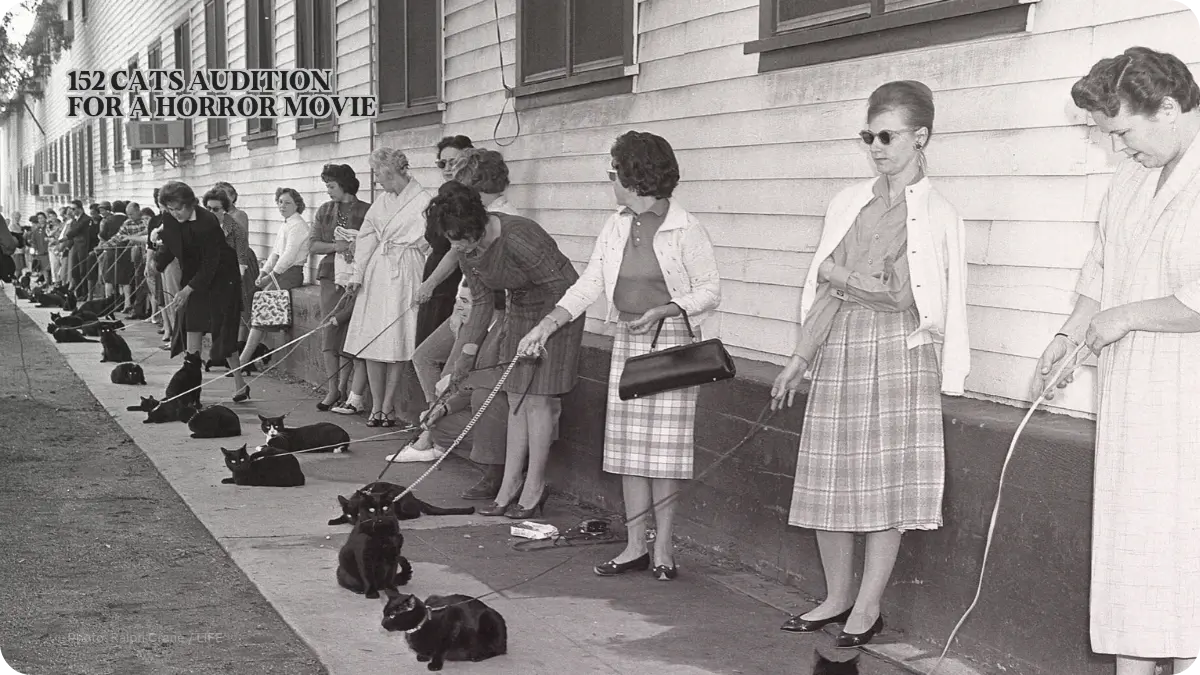
In 1961, a casting call for Roger Corman’s film Tales of Terror, which adapts three Edgar Allan Poe stories, had 152 cats auditioning for roles. Most were black cats, but one white cat reportedly came along to keep a friend company. Even Hollywood knew the value of a black cat when it wanted to make something look mysterious.
Today, the old superstitions survive mostly as stories, symbols, and occasional jokes. They can be pretty contradictory, too. A black cat crossing your path could bring you good or bad luck, depending on the tradition. If one shows up on a ship, it’s good news, unless it decides to bail. And on a baseball field, its reputation really depends on who you’re cheering for.
As for the cat at the Polo Grounds in 1932, it probably had no idea it was blamed for a team’s loss. It just found a ball and thought that was interesting enough.
Share this story
