
October 10, 2026
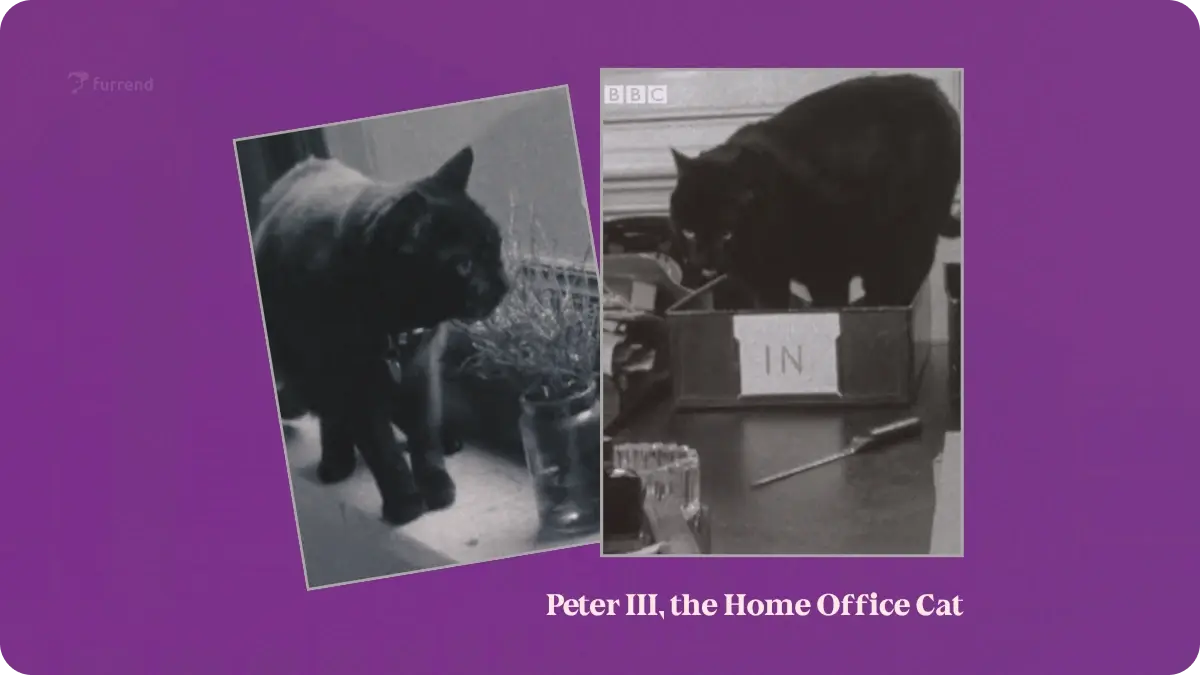
Peter III, the Home Office Cat
In 1958, a government cat received a televised performance review. His career only got more interesting from there.
In 1958, a BBC interviewer asked a government official about Peter's salary, his job, and if he was doing his duties well. Peter earned half a crown a week, spent on milk and meat. His job was to keep rats and mice under control at the Home Office in London. Had he caught any rats recently? "I'm afraid not," the official admitted, but he reassured the interviewer that Peter had done his job well. Peter, who was sitting in the man's arms throughout the interview, was the Home Office cat.

A career in the Civil Service
Peter III joined the Home Office on August 27, 1947, continuing a tradition of government cats dating back to the 19th century. The office started employing cats to deal with mice in 1883. By 1929, officials approved a one-penny-a-day allowance to feed the resident mouser, who was known as Peter.
That first Peter served until 1946, when he passed away at the age of 17. His successor, Peter II, sadly met his end in a road accident in Whitehall just six months into his job.
Then came Peter III, who quickly became the office favorite. He wandered through the Home Office, visiting rooms where he was welcome and hanging out with the staff. As the official explained in a BBC interview, Peter got along very well with his colleagues, who were all delighted to have him around.
Amy Armitage Gough, the Home Office's head librarian, later remembered that Peter liked sleeping on her desk, often on top of her copy of The Times. She once considered writing to the newspaper with a suggestion for its advertising campaign: "Top cats sleep on The Times." Apparently, she was told not to because it might have breached the Official Secrets Act.
A celebrity civil servant
Peter's appearance on the BBC's Tonight programme in 1958 really put him in the spotlight.
He started getting letters from fans, some even all the way from Australia, and people wanted to send him gifts. But there was a problem. Peter was an established civil servant, and civil servants weren't supposed to accept gifts. The Home Office turned down the offers.
Peter's salary was quite the topic of discussion. In 1958, someone complained his food allowance was too low. A Home Office staff member responded by pointing out that Peter had recently left a partially eaten pigeon in his desk, which suggested the cat wasn't exactly starving. His allowance was eventually increased that October to reflect the rising cost of living. But when the government introduced a pay pause in 1962, Peter didn't receive another raise.
When people protested, one official produced an extraordinary piece of correspondence questioning whether Peter could even qualify for promotion. His background was unclear; he didn’t have a birth certificate, and no one had filed annual reports on his work. There were also suspicions that he actually enjoyed publicity.
Then there was the security clearance issue. The official said there were hints that Peter had been “doctored,” but nothing to prove he’d been “vetted.” It was all written with a good dose of humor, but the paperwork was real.
A small incident near the Cenotaph
Peter’s career had its share of drama. On Remembrance Day in 1960, he reportedly left an unfortunate deposit on a doormat just as Queen Elizabeth II was about to walk by on her way to the Cenotaph. Luckily, a quick-thinking civil servant tossed the mat out of a window just in time, and the royal visit continued without incident. Peter kept his job.
By then, he was already the celebrity around Whitehall. He had appeared on the Home Secretary's Christmas card in 1958, featured in Woman's Realm magazine and received fan mail from people all over the world.
The end of Peter's career
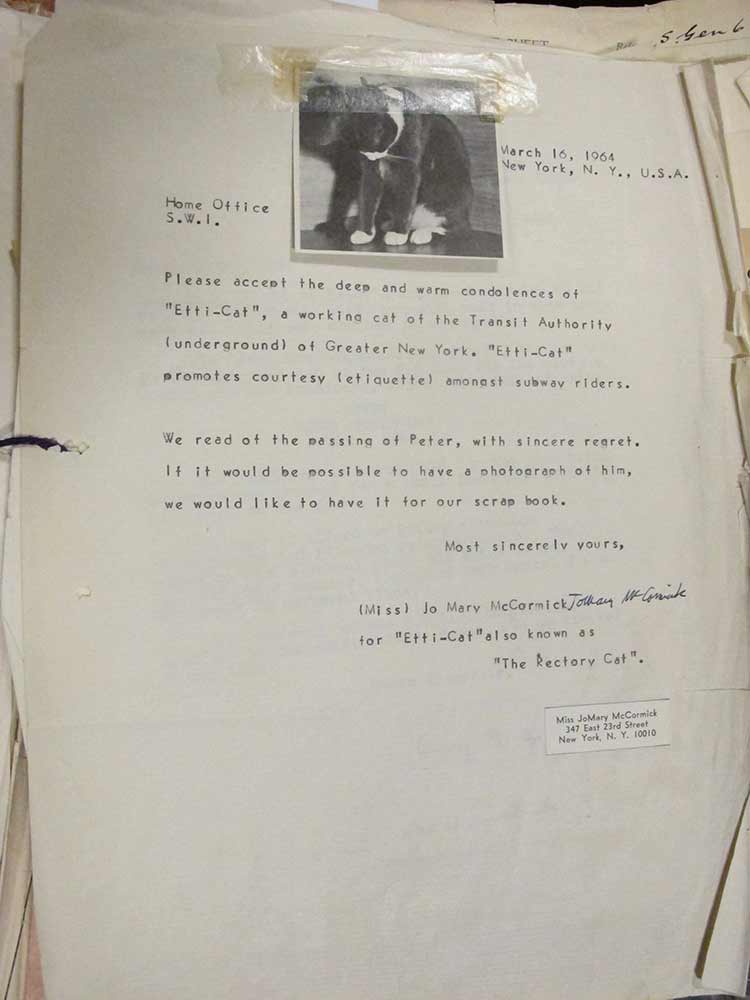
Peter remained at the Home Office until March 1964, when he developed a serious liver infection. He was euthanized on March 9, at about 16 years old, after more than 16 years of service. He was buried with ceremony at the PDSA pet cemetery in Ilford, Essex, where fans from three continents helped pay for his headstone. There was even a condolence letter sent from Etti-Cat, a subway cat in New York, to Peter, a government cat in London, offering sympathy
After Peter, the Home Office brought in another cat, Peta, a pedigree Manx, but she came with her own bureaucratic headaches. Still, Peter had made quite an impact during his time there. He caught mice, visited colleagues, napped on important papers, and sometimes caused a bit of trouble for the officials in charge. Not bad, considering his performance review said he hadn’t caught any rats lately.
Share this story
Animals with jobs
More stories
Furrend circle
Be the first one to hear about updates
