
People and Their Animals Writers
Writer · Andalusia, Georgia
Flannery O’Connor and Her Peacocks
Before Flannery O’Connor became known for her stories, she became briefly famous for a chicken that could walk backward. It started a lifelong thing with birds.
When Flannery O’Connor was five, Pathé News sent a cameraman to her home in Savannah, Georgia, to film one of her chickens. The buff Cochin Bantam could walk backward, which was apparently enough of an event in 1930 to bring a newsreel crew down from New York. O’Connor later joked that she was only there to assist the chicken. But the experience, she said, marked her for life.
- Person
- Flannery O’Connor
- Animals
- Peacocks, chickens, and a farmful of other birds
- Place
- Andalusia Farm, Milledgeville, Georgia
- Years together
- 1930s – 1964
- Known for
- A backward-walking chicken on Pathé News, then up to 40 peafowl at Andalusia
The chicken came first
After the Pathé visit, O’Connor started collecting chickens.
She wasn’t really interested in ordinary-looking ones. She liked birds with mismatched eyes, unusually long necks and crooked combs, and hoped to find one with three legs or three wings. None turned up.
She even made clothes for them. A gray bantam named Colonel Eggbert got a white coat with a lace collar and two buttons down the back.
Then came almost everything else
By adulthood, O’Connor’s collection had expanded considerably.
At Andalusia, the Georgia farm where she lived with her mother, she kept pheasants, quail, turkeys, geese, mallard ducks, and several kinds of chickens. Still, she felt something was missing.
For years, O’Connor had been reading advertisements for peafowl in the Florida Market Bulletin. One day she circled an ad for a peacock, a peahen and four young peachicks and announced to her mother that she was ordering them. Her mother’s first question was whether they ate flowers. Well, it turned out to be a reasonable concern.
She wanted peacocks everywhere
The six birds arrived by railway express from Florida on an October day. When O’Connor first let them out, she announced that she wanted so many peacocks that she would run into one every time she stepped outside. Nine years later, she had 40 beaks to feed.
The peafowl wandered around Andalusia, appeared in bushes, perched on the roof, and greeted visitors with considerably more noise than hospitality. They also ate her mother’s flowers, but O’Connor adored them anyway.
The feeling wasn’t entirely mutual
For all her fascination with peacocks, O’Connor was under no illusion that the birds belonged to her in any sentimental sense. If she arrived with food, they tolerated her. Without food, she wrote, she was basically just another object. Calling them “my” peafowl, she said, was a matter of legality and little more.
That may have been part of what interested her about them. O’Connor watched the birds closely and wrote about their vanity, indifference, strange movements, and spectacular transformation when a peacock finally opened his train.
The birds followed her into her writing
O’Connor wrote about peacocks in essays and letters, and birds repeatedly appeared throughout her fiction. At Andalusia, though, they were also simply part of everyday life. She generally spent her mornings writing and her afternoons tending to her birds, corresponding with friends and receiving visitors. The obsession that started with one backward-walking chicken had eventually filled a Georgia farm with peacocks.
O’Connor once said that the Pathé newsreel had been the high point of her life and everything afterward was an anticlimax. The peacocks made a pretty good second act.
Life at Andalusia
Photographs from the farm show O’Connor among the peafowl, ducks, and geese that filled the place, and the peacock that met visitors in the driveway.

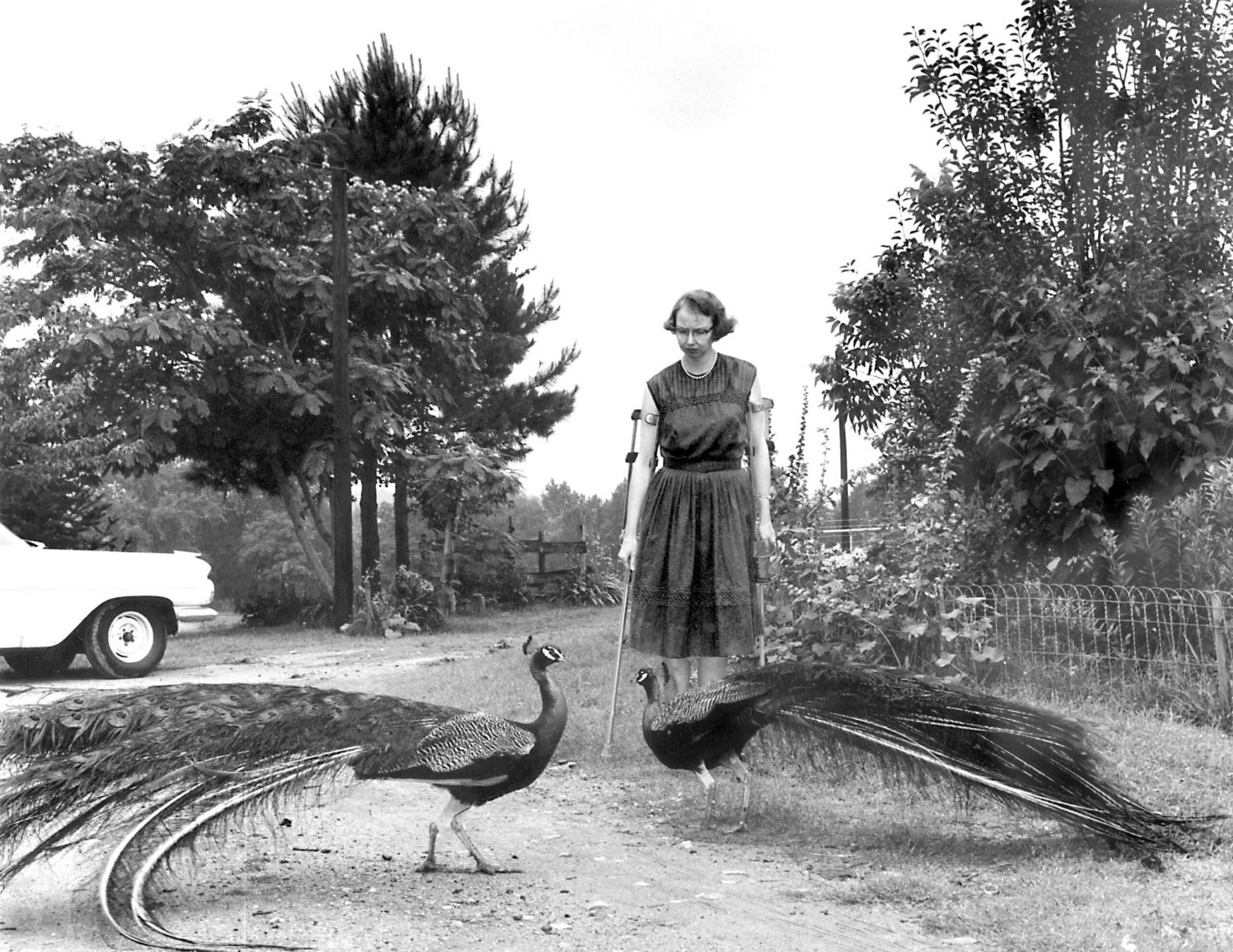
Left: Photo courtesy of Georgia College & State University / Andalusia Collection, shared via The Saturday Evening Post. Right: AP Photo / Atlanta Journal-Constitution, Joe McTyre, via PBS.
Share this story
