
June 16, 2026
Why We Keep Asking Animals to Predict the World Cup
From Paul the octopus to Achilles the cat, meet the animals that became unlikely World Cup fortune tellers.
Every World Cup produces unexpected stars, and every few tournaments, an animal is asked to predict the future. The tradition makes very little sense: a cat gets to choose between food bowls, an octopus picks a box, an elephant kicks a football, but millions of people watch anyway.
For reasons nobody has fully explained, humans love asking animals who will win the World Cup.

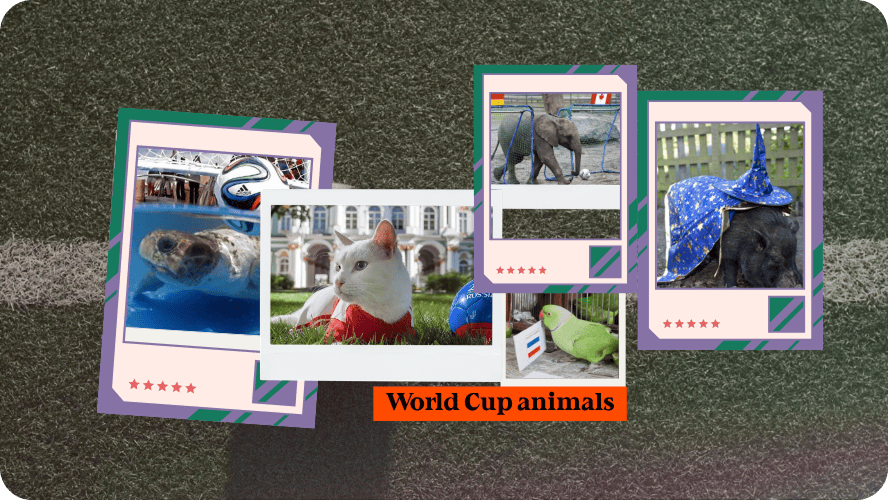
Nelly the Elephant
One of the earliest and most successful football forecasters was Nelly, an elephant living in Germany.
Nelly made her predictions by kicking a football toward one of two goals marked with national flags. Over several tournaments, including the 2010 FIFA World Cup, she reportedly predicted 30 of 33 matches correctly, an accuracy rate that would make many pundits nervous.
Paul the Octopus
If any animal ever became synonymous with sports prediction, it was Paul the octopus living at Germany's Sea Life aquarium during the 2010 World Cup.
Paul's method was simple. Two food boxes decorated with national flags were lowered into his tank, and whichever one he opened first became his prediction.
Against all probability, he correctly predicted 12 of 14 major international matches. By the end of the tournament, he was arguably more famous than some players.
Mani the Parakeet
Thousands of miles away in Singapore, a parakeet named Mani worked from a fortune-telling shop in Little India.
His prediction process was selecting cards bearing national flags. He correctly forecast several key matches during the 2010 World Cup and briefly became an international celebrity.
Big Head the Turtle
Brazil's answer to Paul was a turtle named Big Head.
His prediction results were mixed, but he'd choose between fish suspended beneath competing flags. A third fish sometimes represented a draw, because even animal psychics appreciate nuance.
Marcus the Pig
Marcus the Pig, a Derbyshire resident who made predictions while dressed in a wizard's hat and cape on British television, correctly forecast several public events before confidently backing England to win the 2018 World Cup.
Well, like many England supporters, he was disappointed.
Achilles the Cat
For the 2018 World Cup, the role fell to Achilles, a deaf white cat living in the basement of the Hermitage Museum in St. Petersburg.
Two bowls of food marked with competing flags were placed before him. Whatever he chose became his prediction.
Someone said his deafness might be an advantage because he could not be influenced by crowds or media coverage, which is probably more thought than most prediction systems receive.
Why Do We Keep Doing This?
Because the interesting thing isn't whether these animals can predict football matches. They can't, or at least, there is no evidence that they can.
The interesting thing is that every tournament brings out new volunteers for the role. Fans, journalists, and broadcasters all seem willing to suspend disbelief for a few minutes because sports are already built around hope, superstition, and the possibility that something unlikely might happen.
Athletes have lucky socks, supporters sit in the same chair every match, and entire nations convince themselves that this year will be different.
An octopus choosing a box is really just the same impulse wearing a slightly stranger costume. And perhaps that's why these animals keep becoming famous.
Not because they can see the future, but because watching a cat, pig, elephant, turtle, or octopus confidently pick a winner is a lot more fun than listening to another pundit explain expected goals.
Share this story
